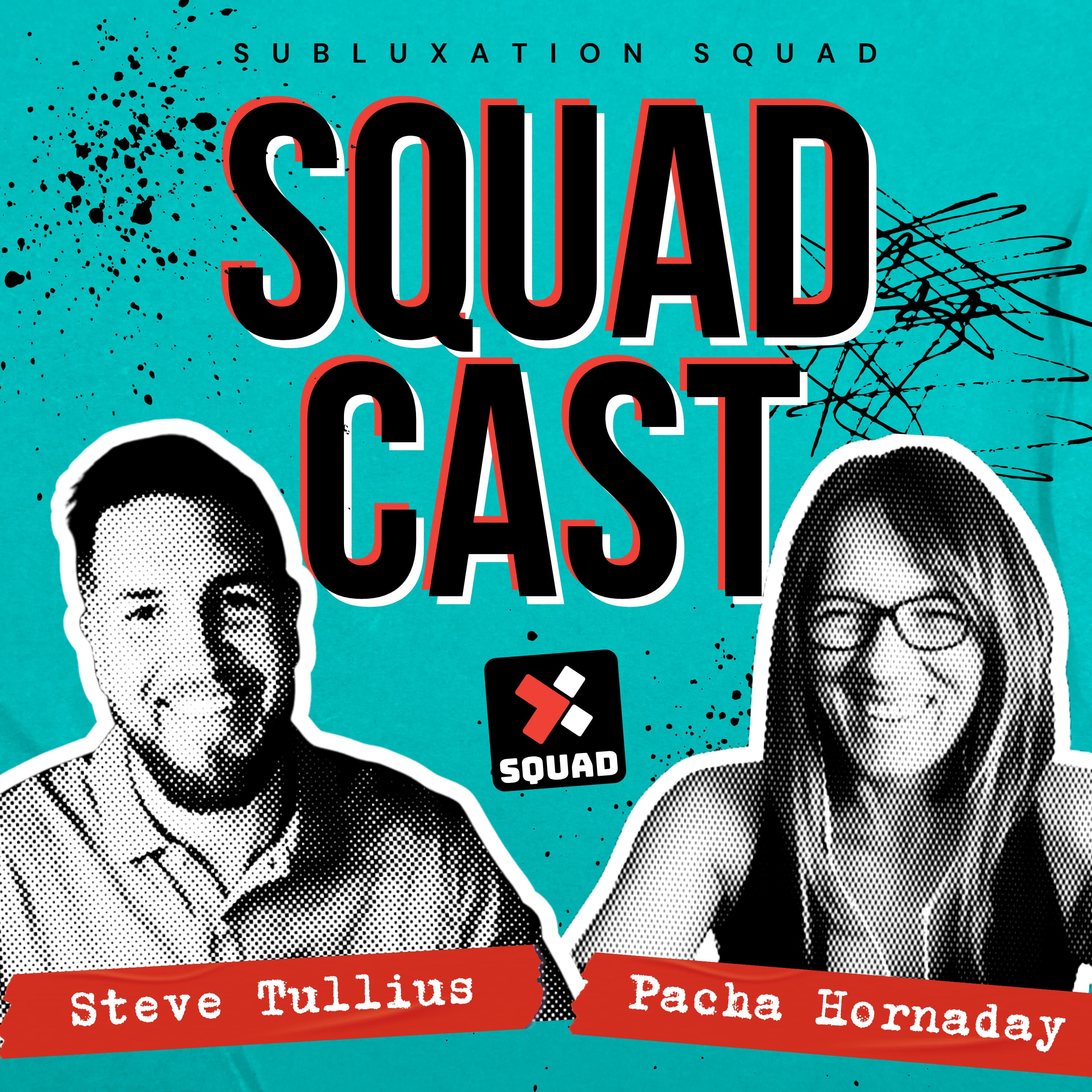
Synopsis
This episode of The Squadcast examines whether subluxation-focused chiropractors should add other therapies to their practices, and what that choice does to brand clarity, public perception, and daily focus. The hosts argue that mission clarity, not the therapies themselves, determines whether added services help or distract from a chiropractor's core purpose. It matters because many practices drift into being generalists without realizing the cost to their identity and results.
In this episode, Steve and Pacha dig into one of the most persistent tensions in chiropractic practice: whether adding therapies, services, and external solutions strengthens care or quietly dilutes its objective. They unpack how contradictions between stated mission and daily actions, especially around symptom-based offerings, can erode clarity, conviction, and public understanding of what chiropractic actually is. The discussion brings business realities into focus, highlighting how financial pressure, insurance models, and operational decisions can begin to influence clinical direction without doctors fully recognizing it. The implication is direct: if the objective of chiropractic is not clearly owned and communicated, everything added to the practice risks shaping the message instead of supporting it.
Key takeaways
- 1
Clarity of Purpose Beats Added Services
The hosts argue that a chiropractor's clarity and conviction about their mission matters more than which extra therapies they offer.
- 2
Public Confusion About What Chiropractic Is
When practices market themselves around trends like softwave therapy, vertebral subluxation and true chiropractic identity get lost to the public.
- 3
Distractions Dilute the Real Work
Marketing, sales, and add-on services can quietly pull chiropractors away from their real purpose, which is the adjustment itself.
In this episode
Jump straight to any moment.
If you liked this episode, be sure to check out
Full transcript
Made by speech recognition, with names corrected. It may contain errors, so check quotes against the audio. Spot a mistake? Tell us.
0:02Should Subluxation Doctors Add Other Therapies
Show intro 0:02
Every doc wants to make a bigger impact. What's getting in your way? You're tuned into the Subluxation Squad podcast. One squad, One mission Chiropractic for all.
Host 2 0:14
How do you feel about, you know, obviously subluxation is the, is the focus. Like how do you feel about doctors adding like, even, even subluxation based doctors adding other therapies into their offer offers or whatever?
Host 1 0:33
Yeah, I mean I don't like it at all. But, but I can't control that. Right. I mean I have.
Host 2 0:40
Why do you not like it? Because it takes away from, yeah, it
Host 1 0:44
confuses the message, it confuses the public in terms of what, what's actually producing the result. The public is very used to an outside in message and any, anything that we add on is going to be, it's, it's more outside in conditioning.
Read the full transcript (9,536 more words, 12 more chapters)Hide the rest of the transcript
Host 2 1:02
So I, I understand what you're saying. From the messaging standpoint, the doctor would still have to talk about chiropractic and what chiropractic is. But like I, I, I personally don't see anything wrong with trying to address the stressors in somebody's lives because in the end it will make, you know, it's like, it's like both ways. Right?
Host 1 1:28
No, I, I completely understand that. So do people slip on banana peels sometimes? If there's a banana peel in the street?
Host 2 1:39
I guess I'm not sure. I've actually never seen anybody slip on a banana.
Host 1 1:43
I mean, how about a snowy sidewalk? Right.
Host 2 1:46
Yeah.
Host 1 1:47
So should the chiropractor then be, you know, providing a service to prevent slips and falls like on a daily basis?
Host 2 1:54
It's a little bit, it's a little bit different.
Host 1 1:57
I'm pushing it.
Host 2 2:01
Should they, I don't know, like nobody should. I think chiropractors should practice chiropractic. But can they offer other things that might be helping their specific audience to better results? Like. I think they can.
Host 1 2:14
Yeah, for sure. Now that's, but you're assuming that they're going to get better results.
Host 2 2:18
So that would be like, for me, that would make the, yeah, that would be the third thing. Like you know, if you're a pediatric clinic and you start offering decompression and you know there isn't like.
Host 1 2:31
Yeah, well, I mean like here's, here's a prime example is Disc Centers of America. And spinal decompression is hot right now. Just like softwave, it's always the next thing. Right. It's not about patient results. Right. It's, it's about making money. Like that's, let's be, let's be blunt about it. It's. Is. Can patients improve from that?
Host 2 2:51
Well, but okay, I'm gonna push back a little bit. It's. I totally agree. It's about making money. In the end, you have to, you have to stay afloat as a, as a doctor. Right. You have to make your clinic work. But it doesn't necessarily mean this has to be a bad thing. Like, if you can.
Host 1 3:11
How about we have this conversation live?
Host 2 3:13
Yeah, we should totally. Although I feel like I'm not necessarily the. You should bring on somebody like this guy or maybe even you're perfect.
Host 1 3:23
I think. How about we have the conversation because you're coming from a branding perspective and a non chiropractor perspective. Ultimately. What. So, and here's, here's one of the biggest. There's two big challenges. One is it's incredibly difficult to be a master of everything. Like, if you, like, there's no way you could do everything for your clients, right. They have a lot of pain points. But if you were to try to serve all of them, then your quality of product is going to go down.
3:31The Difficulty of Mastering Everything
Host 2 3:55
Well, yeah, I wouldn't do that personally. I would hire people to do it. You know, and I mean, there are certain things I can do. Like I do logo design. I, you know, like I can do brand strategy, which is chiropractic. Right. And then I can say, okay, like, I know the next thing some of my people need is a logo. And you can do full service.
Host 1 4:15
You can have full service for sure by outsourcing to the proper people. But at the same time, the branding piece is at the core of the top. Right. And the challenge is that, I mean, remember, remember what all of our guests are talking about is the pro. The biggest problem, clarity, conviction, communication. Right. Of the core thing when those.
Host 2 4:40
But I think, I think that starts with the doctor. Like the doctors need the clarity,
Host 1 4:45
of course, but. But that's the challenge is that they don't. And then they bring on all this other stuff. Right?
Host 2 4:52
But the, the solution isn't like, you know, telling them not to bring on other stuff. The solution is providing clarity. And then the other stuff is just, you know. Other stuff.
Host 1 5:02
Yeah, for sure, absolutely. Like, but, but they don't know that. That's. So, so then, then when we talk about like a brand prop, like the problem with our brand as a whole, right. It's, it's diluting the brand because in general. Right. And then the public thinks that chiropractic is softwave, that it's this, that it's this and this. And vertebral subluxation gets totally lost. A prime example of this is a doctor 30 years plus in practice who his certainty level around, around chiropractic is so like, I was surprised like to hear this, but it, it, it makes sense.
And he even said, as I'm talking to him coaching, he's like, man, Doc, I've forgotten the fundamentals. Like, I'm so glad I'm talking because he started chasing functional medicine and all these things. And the students come out thinking that chiropractic is not enough because couple of things, they don't know how detrimental vertebral subluxation is. They like, they don't know that. They don't believe it, they don't have the science behind it and they don't know how to communicate it. And so then they think that they need to be all these things and now they're in. They're also. And that's the difference between the treatment mentality.
Like there are so many layers to this that the, that the end result, the product, a quality vertebral subluxation, corrective service, because it is now a mediocre service. And that is absolutely like a, a real thing in chiropractic. You know, it's a, A lot of these offices, you know, they're not scanning, they're not doing all these things. It's pop and pray, it's flying seven, you know, adjustments. There's no standard specificity. And, and even the care plan, like understanding, like how many visits are necessary to correct the solitization in various stages.
So we're talking about a real clinical and quality product quality control issue does that. So, so then you.
5:06Public Confusion Over What Chiropractic Is
Host 2 7:05
Look, I don't, I just, I just don't understand how saying you shouldn't do all those other things is going to solve that. Like, the problem is.
Host 1 7:14
I don't, like, I don't say that. Like, that's my. Now before it used to be. And there's. You'll find chiropractors out there. That's the, you know, you shouldn't do this, shouldn't do that. I always tell people, hey, I'm not the, I'm not the chiropractic police. Like, I'm not going to come into your office and tell you what to do, how to practice all these things. I'm going to, you know, ask you questions and you know, you look at results. What kind of results are you getting? Because if you're not seeing miracles on a regular basis, there's Typically, two problems.
One, you're either not attracting the right people, or two, your service, your chiropractic clinical approach is subpar. And that's, that's something that people don't. You know, those. So those are two real problems too. It's like, by. Which is why I also, from a brand perspective, don't feel like it's the best strategy for us to get cultural authority and hit the tipping point with vertebral subluxation. Because until we establish that, all this other stuff just clouds the waters now, again, I know I can't stop people from doing it.
All I can do is massively put all my energy and emphasis on vertebral subluxation so strongly that it, that it drowns out whatever they're doing. And so that's what I consider my responsibility.
Host 2 8:39
Yeah, I get that. I think it just needs to be clear what chiropractic is and what it isn't and that the other stuff isn't chiropractic. But that doesn't necessarily mean that, you know, like, they can't do it. So chiropractic still has the same. Has the same problem. And I understand, like, that for me would be the biggest communication problem that it can look like. You know, like in the ad we just saw, it's like, oh, the chiropractor does the cold laser thing, you know, so is that. That, like, that's chiropractic. You know what I mean?
Host 1 9:12
Right.
Host 2 9:13
So that, that could be confusing. So I think in the communication piece, that needs to be clear. Like, chiropractors do this. And then, you know, me as a chiropractor in wherever, I also offer these services because for my patients, that makes a lot of sense. And, you know, we see a lot of, like, we see better results with it.
Host 1 9:36
So there's a lot of times I, I forget the, the full breakdown. You know, it's talk about, you know, riding a bike or something or tying a shoe. At first you don't know how to tie a shoe or ride a bike. You have to learn. You're conscious that you don't know how, then you learn how, but you're conscious that you're not great at it, and then finally get so good at it that you're unconscious while you're doing it and you achieve mastery. And chiropractic, I mean, like other professionals, many, because of all, like, different schools of thought, different techniques, you know, hold. We have two different professions under one house. The, the.
There's chiropractors that are so confused like they, they don't even know that they're incompetent. And that's a, that's a ch. You know, how do you, how do you help someone understand that they, that there's a better way? Right? And that's through questions typically, not through attack, for certain.
Host 2 10:40
I mean, I see the same thing in branding and marketing. There are so many incompetent marketers out there. I mean, hello.
Host 1 10:48
Right.
Host 2 10:48
You know, so the question would be like, should I even offer logo services? Because that would basically be, you know, offering like massage therapy or acupuncture or whatever. Decompression. Well, maybe not decompression, but you know, like an additional service. Or should I just, I should just do brand strategy because there's so much confusion out there about what branding actually is. So they need somebody like me and other people like me only doing that so that people understand.
Host 1 11:21
What if you said this? Hey, listen, brand strategy is so critical. It's the root and foundation of your entire business structure and the health of your business that you know. And of course there's so many other things like your logo and your, your email header and your website, all those things. Of course those are important. However, I don't even touch those because until the brand strategy is taken care of, you, you can create as many logos as you want. You get the best logo in the world, the best website. But, but it's not going to matter if you don't have a strategy behind it.
That's ultimately what we're saying with chiropractic, right?
Host 2 12:00
Yeah, that's exactly. So if you're saying that with chiropractic, isn't it okay to offer cold laser or decompression? As long as you're saying chiropractic is the foundational piece that has to happen, otherwise you can decompress whatever you want. You're just going to have the same
Host 1 12:18
problem potentially for sure. Now most people aren't doing that. What I just shared with that level of certainty and clarity. However, if, but you know what, what else does it do and says, hey, listen, I, I don't even, I don't do that. I don't have time for that. My, I have to put all my energy and effort on this one thing because there's so many people that need this expert level service. What it does is it positions you as a specialist. Right? What, what people, those people, people are doing is they're positioning themselves as generalists in many cases because all, all those people are doing those things. Right?
And, and yet Here I am a lone wolf, only doing the one thing. It, it creates a, an increased level of specialists, like perceived specialist status amongst the public. Is my opinion on that for you even too, like, if you position it that way, people are going to be, oh, I want, like, you are the brand that makes them think in their minds, well, if anyone else is doing other stuff, they must not be as good as Pacha, right? If they, if they're doing all those other things and Pacha is saying, no, this is the most important thing, that's why I don't do those things.
Now again, it's very easy in both models for people to see how the stuff underneath is supportive and makes total sense why you would do those things. Wouldn't it make sense though, like for you, because you don't do the logo right away. Like, let's imagine you say this like you do the brand strategy first. You take months sometimes just on the brand strategy. Right, let's get that down, then we'll next step. Is that what chiropractors are doing? No, they're not saying, okay, let's set the foundation. Let's do your initial first corrective care program, which is going to be the first 12 weeks.
We're going to do progress exams every, you know, 12 visits. So that way we know what is foundational like and what's still. What is only the effects. See, they're treating effects. And I know this too because I used to give people. Do you remember Dr. Bob Teal? He was in Arroyo Grande, he was a naturopath. He had his own supplement line and it was really beneficial for Aaron, actually. And so he had a form because he sells to chiropractors and other providers all over where people fill out an intake form, all their symptoms.
And based upon their symptoms and where they're grouped, they then that's where the provider then recommends those supplements, prescribes those supplements for those conditions. But what if those conditions are there because that person doesn't have a clear nervous system? All I'm doing is throwing more and wasting money, like, right, so. So that's what they're. So if chiropractors are going to really do this in an ethic, like a fully, like, conscious, ethical way, that is doing what you're suggesting and then they would do it in that manner. But the reality is, I think two things.
One, they don't have the clarity and conviction to understand the true value of chiropractic. They don't know how to communicate it in a way where people will understand that's why we're only doing this first. And two, they don't want to risk the financial loss that they would have by doing it in that manner.
12:22How Brand Strategy Creates Specialist Status
Host 2 15:34
Well, so I get what you're saying, and I also think that, you know, while I believe that I can't really do a logo properly and the right way without having done the brand strategy first, that doesn't necessarily apply to chiropractic. Like, chiropractic has to be there for everything else to work properly and, you know, like, better. So if you, you know, like decompression. Yeah. You know, like you, you can decompress and, and you might feel better. But if you want it to work 100, if you want to get the most benefit out of it, you have to have chiropractic underneath it too. You have to have your nervous system functioning right now.
Do you have to wait, whatever, 12 weeks and do chiropractic for 12 weeks for decompression to start actually, like, working and, and, you know, like doing anything? I don't think you do.
Host 1 16:41
So, but does that person even need the decompression? Like, now we're talking about ethical and moral, like clinical decision making too. Right. So how do you know? Now maybe you could say, well, I've done this long enough to know that these people also really need this too.
Host 2 17:00
Right.
Host 1 17:00
Okay, cool. Right.
Host 2 17:02
I mean, you test, hopefully you look at X rays. Right?
Host 1 17:07
Yeah, yeah. I mean, there's indicators. Right. But again, how do you know? Now you're talking about primarily in a pain model. Right. And relief model. So getting people relief sooner or supporting their adjustment and holding that adjustment. That's going to be the other argument, right?
Host 2 17:22
Exactly. Yep.
Host 1 17:23
Right. What about the argument or the, the what I, the scenario I was using where someone has all these things so that they have, I don't know, a stomach issue, hormonal issue, all these different things, and now we're just throwing supplements at them instead of. And because they have those symptoms, you're basically. That's one, that's the definition of medicine. That's, that is you're actually practicing medicine now and not chiropractic, natural medicine, but that's what you're doing. That needs to be clear. And then two, what if, you know, what if they don't need that?
Like, what if when you remove that interference, that body's able to adapt to its environment and, you know, detox absorb the nutrients it needs to do all the things it's designed to do, which we say that's what chiropractic does. And yet we don't give the body the time. Principle number six, to do what we say it's designed to do. There's massive contradictions here, like, in between principles and, and you know, what we say, what we do. Right. And this is, That's. As the branding expert, you know those, those contradictions are going to eat away at the messaging, conviction, clarity, all those things.
Host 2 18:37
I get that. However, I feel like we should just use. Can we. Is that possible to just use this conversation? I mean, we have to edit.
Host 1 18:47
I think we should do this conversation right now in life. Yeah, I think we. This would be good.
Host 2 18:51
I think, I think we're too far in. Like, I kind of just. Because, like, when we go live, like, we talk differently to each other. Like, is it possible to use this can. I mean, I would be totally fine with this. Like, you know, we edited out this conversation, but I mean, we can leave it in and make it like, hey, this is what happens. You know, we forgot to push the live button.
19:02Why This Conversation Matters for Chiropractors
Host 1 19:12
Yeah, no. No worries. I. I think so. Like, why not? Right? And I mean, it would take some more editing for sure, but yeah, I'd be totally fine with putting this out.
Host 2 19:24
Yeah, I'd be fine with. I think this is a realer conversation than what we would have. Something changes. You hold back a little bit or something. I don't know.
Host 1 19:37
Maybe. Maybe. Yeah, to some degree. So that we don't offend anyone, maybe, perhaps, or things like that. But I also think this. I think that sometimes we do this, this too often first instead of just jumping in, like, because this. I think we would have been very similar to this conversation because you have.
Host 2 19:54
Great.
Host 1 19:55
Your questions are spot on. They're great. You know, I, I've obviously, you know, have my opinions on these, these situations.
Host 2 20:02
You thought about it a lot more than I have because for me it's like, okay, like, well, how about this?
Host 1 20:08
Why not? Yeah, I mean, because. So, so that's the same questions you have right now are the same ones that chiropractors are always posing. And the thing is, they have not thought through it to this depth.
Host 2 20:20
Right?
Host 1 20:21
And they don't. They. They can't recite the 33 principles for the most part. Right. The 33 principles are the things that we say is what the profession is. Right. It's based upon these 33 principles. And if they don't even know the 33 principles or haven't gone through them in depth, how could they even be having this conversation in depth? You know, and that's part of the problem too.
And that goes back to my, what I was sharing before about, well, how do you, how do you help someone understand or have awareness that they might have a deficit in some key area that if they were to address that they would have a massive evolution and growth, a shift in awareness and that, that same question. I guess that's where I need to do a workshop on chiropractic for chiropractors because that's what I've done for the public to help them understand. I had a call with a doc, she's brand new in practice. She went to western states.
I knew she wasn't going to be ready for the workshop programs, but I didn't push the call off because I want to help people no matter what, wherever they're at. And she was so confused. And I could relate because I was so confused when I came out of lacc. And you know, she, she was on the fence where she wants to be this wellness and family practice. But she doesn't want to use the word subluxation. She doesn't think that the public can understand subluxation. And of course, because she was told at her school that subluxation is not real or it's not that big of an issue or. Okay, right. And so it was interesting.
I was, I was just trying to give her some, some advice and, and awareness of. And I don't think that I fully got through to her. Right.
21:19Understanding Subluxation and Its Contradictions
Host 2 22:17
It might take more than one conversation like that. My kids know about supplications, right? Like you have just. Millie, like she's heard about it from the beginning, right? And you know, like all the doctors we've seen were supplaxation based doctors. And our doctor now he brings it up like, like while the kids are on the table, he like, what are we doing here? Like, you know, what am I doing? You know, am I cracking your bones? No, I'm not cracking your bones, right? Like he asked them questions and lets them figure it out.
So I think if kids can understand subluxations, like anybody can understand subluxations, they might not understand it right the first time. And I think the same is true with doctors. Like it, you know, like you, you get new information. Like a little crack opens up and you're like, whoa, hold on. And then you need to sit with that a little bit, let it sink in, let it bring up new questions for you that you try to answer yourself and then hopefully you have somebody who you can go to and say, okay, I thought about this. Like, what about this? Right?
And now you have like new questions and new father for conversation and, you know, opportunity to learn more, maybe.
Host 1 23:24
Yeah. You know, so there I've, I've pondered this a lot, right? And I've, and I speak to, you know, I don't know how many chiropractic conferences I've spoken at. And I, I look at it from this perspective. You know, we talk about if the public knew what we know, if the public knew what we knew, they do what we do, right? That's a common thing that is said or used to be said. And, and so I look at chiropractic practice from a standpoint of contradictions. You know, there's, we say that subluxation is serious. We say that's a big deal, you know, to various degrees. But do we really believe it? Number one, do we believe it at our core?
And then what does that mean then like for society, for a developing nervous system? Do we, do we know that a subluxation in an infant, one, they could die, number one. Number two, if they don't die, which is going to be rare, right, they're not going to, it's not happening probably quickly, that or in mass numbers, that, that's happening all the time. But when that subluxation stays present, do they know that that subluxation totally changes the trajectory of that brain? You know, that being stuck in fight or flight physiology, what that does to developing nervous system? And so do they own that?
And if they own it, then, if they really own it, then are there actions then? Like, what does that mean ethically and morally? What are their obligations? Right? And for me, that means I have no other choice but to do whatever I can to make sure as many people as possible understand this and that it's common knowledge. So all the, so these things will then change your actions and then pretty soon those, all that other stuff in practice, all those other things, man, they become, so they become a distraction, like from your mission, from your purpose, from, from the chiropractic mission and purpose.
Host 2 25:36
Well, but you can still have that mission on purpose. And it's not like, you know, you as the doctor are going to strap somebody to a decompression table. And you know that's going to take away from, from time you're seeing other patients. Plus having that as an option in your office might actually allow you to bring more people into your office and help more people with the chiropractic care you provide.
26:00Chiropractors Distracted by Marketing and Sales
Host 1 26:00
Well, let's, let's take a step back from a business for managing a business, right? How Many of those offices have a full time practice manager, like a. You know, some of them do. However, even so, how many of those offices is the chiropractor involved in marketing and sales? Almost all the time. And so that means that they're putting mental, emotional energy, physical energy into the promotion of those services to make sure those decompression tables are filled. I hear it all the time. And people come to me hoping that I provide that service to fill, to fill that void that's in their practices. It's an expense they have to fill. Like.
So this is. Do you see how this is now? This absolutely is distracting people from the purpose and mission that they say they have. If that's their purpose and mission, if it's not their purpose and mission, then fine. No, if their purpose and mission is to help as many people as possible get out of pain and have great movement and that sort of thing, fine. But if they say that their mission is to. And most of them have it on their walls, you know, many of them is to help as many people in our community be free of subluxation and all these things, then we have a. We have a contradiction.
And that's, that's what I think people need to just sit with. Right. And. And that's hard to really look at. I. Back in. I don't remember what year it was. I don't know if you were a patient in the office at this time. You may not have been. So when you came to the. Into my practice, do you remember therapy B?
Host 2 27:46
Yeah. I used to get like electro, whatever. I don't know what's called.
Host 1 27:52
Yeah. But then do you remember what happened to that room? You should. Because you painted the wall.
Host 2 27:57
Yeah, I painted the, the tree on it. Yeah. Yeah. It just became a treatment room. Right.
Host 1 28:01
Yeah. That room used to be a therapy bay. Right. I had, I had two tables, there was a curtain, looked very medical. And I had a staff member who was applying therapy and doing a little massage after the electro stem with the hydrac layer packs. Right. That was the therapy bay of the 80s and 90s and early 2000s.
Host 2 28:29
Right.
Host 1 28:31
And why was I doing it? Well, I was doing it because that's what my chiropractor did. Right. And I was doing it because now here's, here's why I stopped doing it. I'll tell you why I stopped doing it before I tell you why I was doing it. I stopped doing it because I was at a Cal jam conference and Dr. Nicholas Nikitao, who was a big coach at the time, he Asked this question, he said, if you're doing therapies in your office, if you're doing ultrasound, for example, why are you doing it? Is it because you've seen the peer reviewed published journals showing that you have better results, right.
For your patients, or are you doing it so you could bill a third party payer? And that hit me right in the chest because the reality is I was doing it because I was using that to justify the, the minimal reimbursement I was getting back for an adjustment and I was using that to pad my, my visit bills, right? To get the, the compensation that I felt was justified for the chiropractic adjustment, for the, the real thing, right? And so on Monday, that therapy bay went away. And do you know how many people ask me about that therapy bit? Because I don't think you did. I don't, I don't remember you asking me about it.
Host 2 29:54
I probably didn't know. I thought I liked it.
Host 1 29:58
Yeah, it felt good, right? It did feel good. There was only one person that asked me about it. And when I, when, when he asked me, I said, I said, yeah. So we decided to take it out, you know, because the thing is the, the most important thing that happens in this office is your adjustment, right? And, and the other stuff, you know, yes, it feels good, but it really, you know, it is not that beneficial for you, right, in terms of like what it's going to do for you ultimately, which, the most important thing is that adjustment. Every visit. Did he leave? No, he didn't leave. Now what did leave was 50% of my collections, right?
And I had to, I had to figure out a plan, right? I didn't have a plan. I should have had a plan to probably phase it out, but I couldn't live with that contradiction anymore once I understood that massive contradiction. And so my plan had to become how do I start serving more people? How do I get more people under chiropractic care like that? And that's what I did. And that's what ultimately led to way more miracles, way more people being served and that thing no longer being a distraction in the office. So that's my, that's my story and how I came about that. Well, yeah.
31:11Does Adding Services Interfere with Adjustments
Host 2 31:13
So you, you said you had it or yeah, you had it because your chiropractor had it. That's why you started initially, right?
Host 1 31:23
Yes. And the practice, I took over, so, yes. And I liked it too. When I was a patient receiving. It felt good, right? It felt good. The, the zap. I used to turn it up really high because I could reach it and I'd turn it, see how high I could get it. And, and then the, the short massage afterwards felt good too.
Host 2 31:43
Why do you think it's a bad thing to make money off something like that? If it feels good to the patient? And that's maybe is the question, if it doesn't do any harm. So the question would be, does it do any harm? Does it interfere with the actual adjustment, you know, the reason why they're in the office in the first place? I guess that would be my first question.
Host 1 32:06
Well, I mean, that's the thing. Going back to our. There's a couple things there. One that's unethical, like if to be doing it simply because people. It feels good versus it being clinically necessary. Right. That's, that's.
Host 2 32:21
So what would be the, what would be the ethical thing to do to ask them, would you want this because it feels good?
Host 1 32:28
The ethical thing to do would be to be super clear that this approaches, you know, this type of care, which in that mentality is a treatment.
Host 2 32:39
Right.
Host 1 32:40
I almost do the word treatment. I always try to not to use the word treatment because that's not chiropractic. Right. But in that case, it is a treatment. So does this treatment. Have you seen the. Are you crystal clear that the research shows that this is effective and clinically indicated for that patient? Right. Especially if there's a third party pair involved. Right too. Even if there's not. Right. Because the patient, if there's no third party pair, then the patient is to be paying for that service. Right. So, so is it clinically indicated? That's, that's our job, number one.
So if it is, now let's assume it is clinically indicated because based upon your best judgment, you, you're, you're certain you feel good about that? Well, then the next question becomes, you know, you ask, well, why. Why would it be bad? And then it goes back to again, the, the distraction that it creates away from someone's purpose.
Host 2 33:39
But I don't understand the distraction, like you do your chiropractic, like whether or not you have another person there that makes your patients feel good before or after the adjustment. Like, how does that distract you? I mean, you know, in the billing part that you worry about, like having to, to bill for or having to fill the tables or. I don't, I'm, I don't understand what the distraction was for you, particularly with that, with that. Bay.
34:04When Insurance Reimbursement Changes Services Offered
Host 1 34:05
Well, for me, let's take a, that's a perfect example. My Collections were cut in half. So before that, no problem. Mentally, okay, everything's good. I'm at this collection level, Things are good. Did I still want to grow? Yes. But now I'm at a place where, okay, I just cut out 50 of my collections. Now I have to, I have, you know, we, we have to serve more people too. Like, so. So I was comfortable at a certain level, I was comfortable serving less people, let's put it that way.
Host 2 34:41
You think? So that's the problem with, like, decompression. And like, it's, it's like decompression is just because those are big care plans. Right. If somebody, like, gets decompression, it's a lot more than, I don't know, massage or whatever.
Host 1 34:57
Oh, yeah, the goes.
Host 2 34:59
Yeah, exactly. Right.
Host 1 35:01
Because. And so if, if you look at, throughout the history of chiropractic, at what therapies come in to the scene, it's typically because they. Those therapies have the highest reimbursement from insurance. And guess what happens when insurance changes and the reimbursement goes down or away from. For those therapies, all of a sudden those therapies are no longer clinically necessary.
Host 2 35:25
Right.
Host 1 35:25
I mean, don't you see a pretty massive contradiction there? If people are doing it primarily because it provides the greatest financial benefit, and then once that financial benefit goes away, now the service is no longer offered. I see that as a major issue.
Host 2 35:47
Yeah, I guess it's. I, I don't. I mean, I get what you're saying. It's, you know, it's an ethical question. For me. I don't know. I don't know how I feel about it personally. Like, I, like, I sometimes feel like I would like some additional help in addition to chiropractic because, like, you know, I get massages because my muscles are tight. And in the end, that's one of the stressors on my, on my nervous system. It's. Yeah, I don't know. I guess it comes back to why you're doing it, really. And once you're, Once you have the machine, you need to use it. And once it brings in money, you want it to keep bringing in money.
Host 1 36:37
Those are expensive machines and they're paint.
Host 2 36:39
They.
Host 1 36:40
They're not typically paid for. Like, they're paying a month. There's a monthly. I mean, I don't even know the, the amount. Like 60,000, 100,000, you know, for some of these. And so people, they have to. And then they're paying a person to apply the. Right. So now you Got paper roll, you got to pay for that person's livelihood. So these are the district. Like, these are the distractions that start building up, right? And, and so, you know, I don't,
Host 2 37:08
I don't know how often. So like, is this usually what happens? Like, I don't know. What's another example for therapy that was reimbursed ones and now isn't anymore, and now nobody's doing it anymore.
Host 1 37:21
Well, IV therapy is like a new one that was in some areas reimbursed super high. And then all of a sudden it gets, the plug gets pulled. The Mercedes 80s is a great example. So this is. So in the Mercedes 80s, it's called Mercedes 80s because insurance was reimbursing at a crazy rate for, you know, for everything. So chiropractors making over a hundred dollars per visit through insurance with, you know, small co pays. In fact, they would, they would waive the co pays, which is illegal as well. You can't do that.
And that's when, so that's when all these quote unquote, you know, these what were, you know, considered straight chiropractors all started adding all these therapies. And, and so there was these, this massive contradiction at the time because they were saying one thing from the stage and then in their offices doing all these other things. And it was all justified based upon financial reimbursement. Well, that was in the 80s, in the 90s, and I believe this was all purposeful. So I believe this is a very purposeful move by whoever wants to contain chiropractic to enslave us. Because now chiropractors were dependent upon the insurance dollar.
And in the 90s, the policy and everything shifted to HMOs, and now HMOs, they pulled the rug out. All those therapies that were being reimbursed, the great reimbursement rates was all pulled away. And now you had all these chiropractors dependent upon insurance who didn't know how to build and maintain a cash practice, you know, you know, practice that could sustain itself. We're now stuck in this, this HMO world where now they're getting reimbursed $22 a visit. And, and I believe it was a plan to enslave chiropractic and get them stuck in this, this system.
Host 2 39:30
What's the, what's the solution to this? Because I feel like not offering the, the, those therapies or whatever you want to call them isn't necessarily the right thing either, because it can really support, it can really Support the business. You know, if it's like if you do it the right way, it can really help people too. It's not like, like any of those therapies. Like you know, they're all just like money, whatever machines, you know.
Host 1 39:57
Are these things beneficial like for people? Yeah, like I'm not saying these things aren't beneficial. Like one of our principles is, is about the limitations of matter. Some of these, these, these different things help it address the lim and, and so. But that's also not our objective as chiropractors to address the limitations of matter. That's very clear in our principles that that's not our objective. Our objective is to address the missing link between intelligence, force and matter. Right. That's, that's the. And we should talk all about the triune. Sometimes we gotta get some deep conversations with some philosophy people soon.
But anyway, the, so the solution goes back to one. Okay, one thing. Hey, I think it's okay to do these things if you want. Like I'm, I'm certainly not going to stop anybody. I don't, but I don't encourage them to stop. I put many clients who, who utilize these different services and their practices. Right. I think the solution number one is being crystal clear on the mission. Right.
And then how do you communicate this, you know, the seriousness of subluxation, that it's foundational, that you have to have a clear nervous system, that, that all those other things, you know, consider putting those other things later in a care plan potentially. You know, unless it's maybe if you're a pain based office and you want to give people immediate relief. I could see that. However, I think the bigger solution, the biggest subluxation. We wouldn't be having this conversation if there was a demand for subluxation centered chiropractic in a nervous system solute genic model where we were helping the sickest of the sick. Right.
If we, if we created the demand they wouldn't have time for all this other stuff, right? Yeah.
40:37The Case for a Simpler Practice Model
Host 2 41:49
And it's possible and you know, when we get there it might still, you know, like I don't, you know, I don't necessarily think they, they eliminate each other. I mean if you have a chiropractor can make, you know, can prosper not just like, you know, make it like somehow, you know, but actually prosper and thrive with your practice just doing chiropractic like that's way easier than buying a whatever a hundred thousand dollar machine and then having to fill it. Like obviously if the demand is there, I think Every chiropractor should just do chiropractic.
Host 1 42:26
It's a much, much simpler model. It's a model that is person like for most people it's going to be more personally fulfilling because at the end of the day, what they're many times are not looking at is what, what's actually going on inside. Right. They want, they want the other thing. They want the family practice, they want the p. All the kids and, and helping the sickest of the sick and seeing the miracles. That's why they went into chiropractic college and now they're not doing it. That's a massive contradiction that eats at the chiropractic soul and that person, that person's core happiness.
So what if we look back at some of our guests? Joe Borio. Right. Five hundred a day. Now, I've never done that. I've never even close to that. Right. Not everyone wants that or, and can get, you know, could physically do that. But 200, 250, 300 per week, that's, that's super doable. The challenge is that most and most chiropractors would be really happy in 100 if they were had a 100 cash peds, family wellness, helping the sickness of the sick. You know what chiropractic always was. They would be really happy making a great, you know, income which even potentially rivals these incomes of these other practices because of the high overhead.
If they were doing it 100% cash model. That's, it's so the stress is so much lower, the happiness is higher. So, so we've had lots of guests on the show doing that. That's what they're doing. And so it is highly available. The need is there. You know, their communities aren't. There's no shortage of people in our communities. So if they could find those mentors doing it and, and see it happened that it's real, then maybe more people would move towards that.
Host 2 44:29
Yeah, I agree. Yeah,
44:31Aligning New Services with Your Brand
Host 1 44:33
you have awesome questions on this and I think it would be great for us to bring on some other people who, you know from both, you know, vantage points. And again, at the end of the day, it's not about making anyone wrong. Like, it's, it's just about what's right for, like what's right for you and your heart. And have you really evaluated these things or have you just have you brought in to fill a void? And if it's just there for that, then that's never going to feel good.
Host 2 45:06
I mean that's, you know, that's how I can bring it back to a brand strategy. Because if you're clear on your purpose and you're clear on your vision, then everything down the stream will become more clear too. Like, you know, which services, if you want to bring them on, you know, does that, that align with my values that I'm clear on in my values in business, my personal values, you know, and with my purpose on what I, what I see as why I'm doing this and my vision of like where am I trying to go with this? Does it align with all those things? And then if that's a clear yes, then this is something you should do.
And if it's a maybe, then you need to think about it like, okay, like what is not aligned and am I okay with it or am I not okay with it?
Host 1 45:50
Yeah, I mean, is it, is it a band aid? Are you treating the symptoms by bringing this thing in? Are you doing something just because your colleague down the street or someone else is doing it? Or have you done this really deep analysis in alignment with your brand strategy and your vision and purpose? And now it feels great because I could see it working there, right? I could see someone who's super crystal clear, right. In their vision, purpose, mission around chiropractic. And, and, and I see it, right? It's not like this doesn't exist. I see it in people I talk to all the time.
And now they're also, they're just passionate about helping people get back to their, you know, their daily activities, weekend warriors, athletes. And so they're passionate about this thing or this thing maybe helped them a lot too.
Host 2 46:38
Right?
Host 1 46:38
Cool. Like, you know, run with it. Like I bet that that in that model that person's going to be, it's going to work probably really well and they're not going to lose that focus on the, on the main thing. I think that's a great conversation for the profession and hopefully I didn't piss too many people off.
Host 2 47:02
I don't, I don't think so. I mean the conversation is out there anyway. It's just not in the public. It's like, you know, people complaining to each other about it. Oh, he said that. And you know, he's such an idiot. Doesn't he know about this part? And then on the other side of the table they're doing the same thing, you know, saying how the other person is stupid because they're so narrow minded and whatnot. Like, you know what I mean? Like that's what I see out there. Yeah, that's, you know, I'm Just trying to understand it all. You know, it's like getting in there, like, okay, I can see this, but I can also see this.
Host 1 47:38
Yeah, that's what I love about your perspective is that helps bring. Bring the questions, the. The right questions up and helps create clarity for everybody. Right. And. And even, like, my ability to communicate things. I know in the past I was, you know, it's. This is. This happens. This is a conversation that would be great for the profession. This happens a lot. A chiropractor is at a certain place, and. And this happens not just in chiropractic, but. But with people in general. They. They gain a new awareness. And at first it's, you know, it's new. And so what do they end up doing? They end up attacking, what, the old belief system?
Right. And they start attacking people holding that old belief system. And it's a function of trying to strengthen their new belief system.
Host 2 48:30
Right.
Host 1 48:31
But it's a sign of immaturity and not for, like, really just being in a place of being able to communicate the value of your new belief system and why you're there. And I know I certainly was there. I could definitely get better at sharing, you know, the whole. My whole beliefs around this. But I think also ultimately what you helped me see today is how do I help chiropractors, you know, analyze their own beliefs and, you know, where they can. Where they could potentially grow, where there might be some areas that they can grow into to serve more people.
Host 2 49:10
Yeah, I think it's important to share the journey. Right. Like, you didn't, you didn't plop there. You just spawned in this, you know, with this belief system, like, you actually grew into it, and obviously you didn't start out as, you know, where you're at. So I think that's important to share. Like, this is, you know, like, it's, It's. It's a growth path, just like with anything else. Just like you're growing your skills, you know, you also have to grow that part of your. Of your business, I guess, the beliefs and the philosophy and. Yeah. Just the purpose behind it.
It's like you think you're clear on it until somebody digs a little bit deeper and you're like, whoa, whoa, whoa, whoa, hold on. I know I've thought about this before, and I know. I know what I, what I mean, I just, Just, you know, I don't express it often enough. That's what I, that's what I, that's why I notice with a lot of my clients, like, you know, they have those really strong beliefs and they have those really, you know, they're really emotional about why they're doing what they're doing, but they don't express it often enough. And we have to, like, really dig and find it. Like, why? No, tell me more.
That's just like, you know, the surface. Like, let's go deeper.
Host 1 50:18
Yeah. And you use a. I think a key word there is. They're really emotional about it. It. Right. And when you're, when your certainty is grounded in emotion, it. When you're, when your beliefs are attacked, how does that, how does the communication typically come out?
50:39Addressing Erroneous Beliefs Within the Profession
Host 2 50:39
Well, you react emotionally, probably too.
Host 1 50:42
Yeah, yeah. And I, I can identify with all that. I've been there because I didn't own chiropractic. I didn't own all those things I talked about. I didn't own the principles. I didn't, you know, I never studied them in depth. I didn't own the science. I had never studied that in depth. I didn't work through all these pieces to have such, like, an airtight awareness and belief system and knowledge base around chiropractic. So that was. So there's no way you can possibly communicate chiropractic if you don't have that.
That, you know, you might be able to sometimes, but then if you're, if you're challenged at any part now, your communication is going to break down and you go into fear, typically, and reaction and defense instead of a place of, you know, ease and smiling and like, oh, that's curious. Tell me more about that belief. Right. And then you. You deconstruct their beliefs in a loving way, too. Because these people, you know, the public isn't looking out to get us. Like, you know, yes, there are some people that really have hardcore erroneous beliefs about what chiropractic is, and we don't need to save all those people.
But the vast majority of people are not skeptics. They're just, they're curious and they've heard things. And so we need to look at them as children almost. Right. And in a loving way, like, just smile at these questions or these misperceptions and help take them on a journey where now they, you know, now it makes total sense what chiropractic is.
Host 2 52:16
It's not so much the puppet that I'm worried about, to be honest. It's the way chiropractor attack each other that's, like, almost more concerning to me because sometimes there's like, no, maybe it's just because it's online and there's no filters, but I don't know, there is attacking, calling each other names and. Or just like dismissing it, which is almost worse. Just laughing at it. It's like, yeah, that's funny.
Host 1 52:46
Yeah, I think that's a totally different conversation. We should have that conversation. For sure. I'd love for us to have that conversation, either, you know, the two of us or bring some others in on how we, how we operate as the profession. You know, ending this straight versus mixer thing and that type of terminology. I don't even see much anymore. I don't participate a lot on. In the Facebook groups because I, I just don't see the. I didn't see it moving me forward where I'm at now. In the past, it was really beneficial to work through my belief systems. I'm talking about. Right. Because I wasn't clear. So, So I was. I was fighting with.
Not my, not my brother or my sister or my close cousins. I was fighting with the bastard stepchild. That exists inside chiropractic. And that's a different conversation. Maybe we titled the episode that because. Because there's. There's an element of people who call themselves chiropractors in our profession that have no legitimate right to be called a chiropractor. And I'm exceedingly clear on that. They violate our core principles of all natural right. They want to add drugs and surgery and they want to remove the word subluxation. Those people. That's where I think we have to have some clear boundaries. We don't have to call names. Right.
We can have a civil discussion and let them know. Hey, hey, listen, I understand you feel this way. However, you really don't have any right to this conversation. You've never read any of our works. You've never done any of these things. So I won't be engaging you any further. Right. So. And, And I'm also actively going to work to try to stop your, you know, what you're trying to accomplish, because what you're trying to accomplish is bad for. For my profession. And I think that that's totally, you know.
Host 2 54:53
Yeah, I think you, I mean, you could, you know, and that's true in any, Any discussion, I guess, you know, to see the other point of view as a, As a. Like a practice run maybe, or like a challenge to just become clearer in the expression of your beliefs. You know, just like honing your skill of explaining and. Yeah. Just sharing what it's all about, like what you believe, you know, like that's. I think that's how we should approach it, maybe as difficult as that is.
Host 1 55:30
Yeah, it's difficult to consciously go there like, so I would encourage anyone who may be listening to this too to try to start to go there. If you find yourself like getting angry and you know, agitated, take a step back. It's really one you're allowing someone else to, to shift your emotions like that, which I remember, like I remember getting angry and that was because I didn't have solid footing in my belief. So, so just check in with yourself if you're going to that place.
There's likely an area in philosophy, art and where you don't have solid footing yet and have the ability to rationally and non emotionally express your beliefs and your positions. So I did that in two places. I did that professionally and I also did it with the public. When there would be people, you know, the trolls, I would, I would feed the trolls. Now I tell people all the time, don't feed the trolls. But there is value in feeding the trolls. The, the value in feeding the trolls is to use it as that test run. Excuse me, like you're talking about.
And, and now, now those trolls are in captivity, like you have them captive and they no longer have you captive and now you're just periodically playing with the trolls, you know, with it, with the, with the barrier, with the bars and, and you can refine and hone your skills.
Host 2 56:55
That's a good place to start. So I think getting clear on what, you know, what you're actually trying to say. So being clear on your purpose, why you're doing what you're doing, being clear on what you're actually doing and why you're doing what you're doing. So, you know, if you bring any, anything besides chiropractic into your, into your office, be clear on why you're doing this. Yeah. And then just practice communicating those things. I think that's a really good start for anybody, right?
56:56Clarity of Purpose Transfers to Your Team
Host 1 57:26
Yeah, absolutely. Yeah. And with your teams too. Right. Because the teams, your, your, your clarity is transferred to your team. So, so you have to make sure otherwise they're, they're going to communicate it at a lesser degree than you do. Right. So it's got to be all ingrained into your systems, you know, if you're going to get that point across.
Host 2 57:48
Very cool. Cool. Great.
Host 1 57:50
Well, I'm glad we did it in this, this fashion today. This was really cool. We should, we should do it this way more often and just share these, these fun conversations.
Host 2 57:58
Yeah, maybe. I think so too. I mean, it's not live, which is kind of, you know, But I think it's a. Like, if we do this every once in a while, I think it's. It makes sense. Like, we can share it and say, so this is what happened. And we record all our calls, and we didn't get to go live because we were so in the discussion. But here's what happened, sort of.
Host 1 58:20
Here's what happened, everybody. They're listening to it now, so.
Host 2 58:23
Exactly.
Host 1 58:24
All right, awesome. Well, thank you, Pacha. I'm gonna hit pause and stop here, and thanks for listening, everybody. Bye.
Host 2 58:31
Yeah, till next time.
Subscribe and review
If this hit, help another chiropractor find the show.
If you love this episode, please take a moment to subscribe and leave a review on Apple Podcasts or Spotify. Your support helps us reach more chiropractors who need these insights. Thanks for tuning into the Squadcast. See you next week.