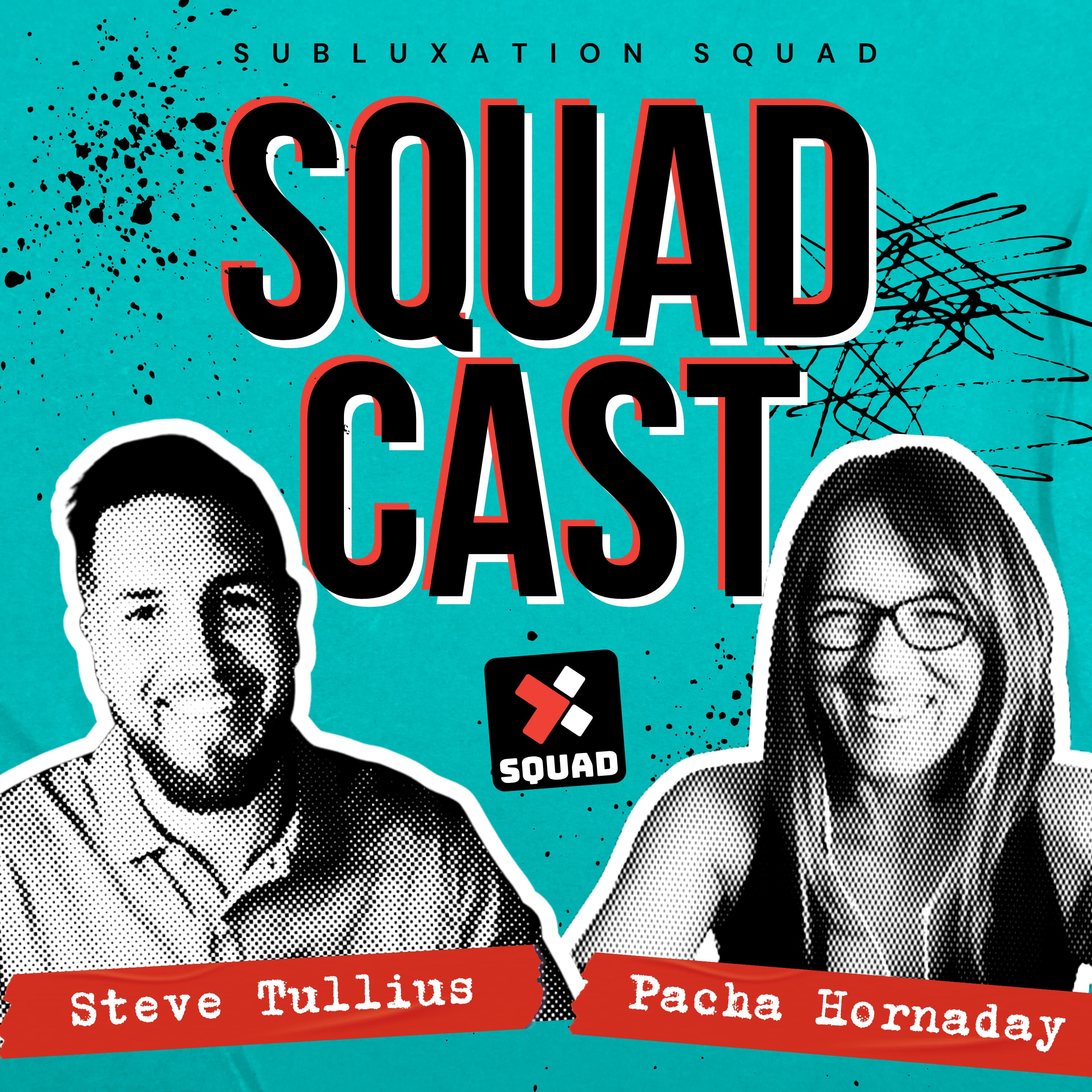
Synopsis
This episode of The Squadcast explores how chiropractors can apply subluxation-focused thinking to their own businesses, examining branding, coaching, and team building as tools for growth. The hosts discuss why many chiropractors struggle to treat their practices as real businesses and how outside perspective, clear messaging, and understanding levels of consciousness (spiral dynamics) can help close that gap. It matters because it reframes common practice problems, like new patient generation and team management, as symptoms of deeper, fixable root causes.
In this episode, Steve and Pacha dig into a tension many chiropractors feel but rarely define: how do you deliver inside-out care while operating inside an outside-in marketplace? They clarify the objective of the adjustment and unpack how marketing language, business pressures, and symptom-focused framing can slowly shift emphasis if left unchecked. The discussion separates philosophy from operations, positioning systems and financial structure as necessary supports rather than drivers of care. They ultimately challenge chiropractors to consider what is truly driving their care, and whether outside-in thinking has quietly started dictating an inside-out message.
Key takeaways
- 1
Coaching Reveals Hidden Practice Subluxations
An outside coach can help chiropractors spot blind spots in their business the same way they identify subluxations in patients, rather than just treating surface symptoms.
- 2
Clarity and Differentiation Build Strong Brands
Chiropractors need clarity on who they are and what they do, both to stand apart from other approaches to health and from other chiropractors.
- 3
Spiral Dynamics Shapes Communication and Marketing
Understanding different levels of consciousness helps chiropractors adjust their messaging so patients, teams, and the public actually receive it as intended.
In this episode
Jump straight to any moment.
If you liked this episode, be sure to check out
Episode 44
From Smile to Spine: The Missing Link in Whole Body Wellness with Dr. Gary Glassman
Episode 40
Awaking the Bigness Within with Dr. Wade Port
Episode 33
Why Telling the Story is Hurting your Practice and the Profession with Dr. Martin Harvey
Episode 25
Translating Beliefs and Vision into a Successful Legacy Driven Practice with Dr. Sabrina Gya
Episode 11
Making Chiropractic Relevant with Dr. Mark Romano
Full transcript
Made by speech recognition, with names corrected. It may contain errors, so check quotes against the audio. Spot a mistake? Tell us.
0:00The Allopathic Trap in Chiropractic Business
Show intro 0:00
Foreign. Wants to make a bigger impact. What's getting in your way? You're tuned into the Subluxation Squad podcast. One squad, one mission. Chiropractic for all.
Dr. Steve Tullius 0:17
Hey, Pacha, welcome. It's good to see you again on another episode here.
Pacha Hornaday 0:22
Hey, Steve. How are you today?
Dr. Steve Tullius 0:24
I'm doing great. Yeah. I love, I love these days. I love every time we get a chance to chat and we're. Whether or not we have a guest or not, we always have some great conversations. So, so much to talk about. Yeah, for sure. But you always bring some of the best questions. Right. And, you know, you not being a chiropractor, you get to see, I think, some of our blind spots that we don't see because we're so involved in chiropractic. We're so involved in our practices. And so you. You had some really great questions for me earlier today when we were just chatting before we jumped on here. So I'm excited to dive into this topic today.
Pacha Hornaday 1:00
Yeah, I, you know, I, I know that I appreciated myself when I learned from other people outside of my industry, because you just.
Read the full transcript (6,966 more words, 10 more chapters)Hide the rest of the transcript
Pacha Hornaday (continued) 1:00
They just see things differently. Right. It's like if you're in your own little world, like, you talk with. You talk with your people, you speak the same language, and you kind of go in circles. Right.
Dr. Steve Tullius 1:19
So, yeah, we. We do that a lot. I mean, all people do, but chiropractors, specifically, because we're. We're outliers.
Pacha Hornaday 1:26
Right.
Dr. Steve Tullius 1:26
And we've been attacked for many years. And so we tend to really stick together and then show up at the same things all the time and not branch out into other industries and talk to other industry leaders and things like that. So I'm curious, as an industry leader, outside of chiropractic, as a brand specialist, what are some of the things that you see when you're working with chiropractors that really stand out to you?
Pacha Hornaday 1:51
Yeah. So one thing that I brought up to you earlier, which made us like, hey, we should talk about this on another episode. One thing that I've noticed with some of the clients I'm working with and even listening to some people, whether they're chiropractors or not, but even chiropractors that are, you know, coaching or are being in a vendor space helping other chiropractors, a lot of the, the, the way they talk about helping them has a very allopathic feel to me, which is like, I can fix you your business from the outside. And I'm kind of, you know, as I learned about chiropractic, philosophy. I'm still, you know, I'm still learning.
I never went to school for it, even though I heard schools don't teach that stuff anymore. As I learn about it, it makes a lot of sense. And when I, when I see it from a branding perspective, I think too, that coaching and, you know, like, your brand needs to start from, from the inside. Like, you can't fix something from the outside. And it's, it's such a, it's such a statement in chiropractic. And a lot of chiropractors don't seem to apply that to their business. They want their patients to understand it, that healing happens from the inside out. Right. And then we just removed interference.
So innate or whatever you want to call it can do its thing. I think in the business space, I see very similar things. It's not like people don't know what to do. They just need. They have interference and that needs to get removed. But it's like, like, let me help you from the outside.
Dr. Steve Tullius 3:29
Yeah, yeah. So I think there's. Do, do people always know what to do, though? If, if you're a chiropractor, you don't necessarily're. Not necessarily a great business person.
Pacha Hornaday 3:40
That's true. That's true. So, however, like, what, what I see, what I see, you know, from, from a coaching perspective, especially, or even like any successful chiropractor, like, I figured out something that worked really well for me. Right. And then I'm like, hey, I, I see you, you're struggling with something and your business isn't growing. Take what I did just do. Exactly. I'm giving you my blueprint, my framework. Just do what I did and you will be successful too. And that most cases, it's just not true. It's, it's true in some cases, maybe even a lot of cases, whatever it is, but it's not always true.
And I feel like there's a disconnect because there isn't, there isn't enough talk about why it worked. And that's, you know.
Dr. Steve Tullius 4:31
Right. You. So, so to just, to take a blueprint and apply it, you know, just try to apply that blueprint. That's a very mechanistic approach. Right. It's not, it's not vitalistic at all. It doesn't take into account, you know, you know, some really important things like the, that individual and their, their, the nature of their culture, of their, their business, their brand, all those sorts of things. I've really seen this even with my own workshop company, you know. Right. I Was I was taking it from a very mechanistic approach, like, okay, we'll get the butts in the seats and we do that. However, I had a.
I was very successful with it, not only because I was getting butts in the seats, but that's just one step. You know, the vitalistic piece is how I was taking people from a belief that chiropractic is good for neck pain and back pain at best, and helping take them to the end where now they understood that they not only would their major health challenge should be getting checked, but their entire family. And that's an art form. And I didn't understand that at first. I tried to just like, okay, here, here's the butts in the seats.
And here, you know, say this instead of now really understanding the principles and the how to help individuals uniquely express those principles themselves. Not trying to be me. And so systems can work, but like, you're sharing. It has to be around principles, you know, that you adapt for yourself.
Pacha Hornaday 6:07
Yeah, I agree. That's, you know, there's foundations and they like, you know, any of the guests we've talked to so far, I think they all have agreed on systems and then, you know, having clear principles that these systems are built upon, like, you need that solid foundation of the understanding of whatever you stand for, really. Like, everybody can define that for themselves. You don't even have to agree on, you know, on it with other people necessarily. It's helpful for the profession if there's some kind of agreement because it just makes it easier to communicate it with the public.
But in the end, like, you have to be very clear on, this is what I believe in, this is what I stand for. And then the systems are built on that. And I think that's this foundation is what's lacking a little bit. Not that I don't even, I don't even want to say that the chiropractors don't have the principles or don't have the beliefs. You know, they're just not clear on it. And then how to use them with the systems that they're being presented from, you know, people who've been successful.
Dr. Steve Tullius 7:10
Yeah, absolutely. And the piece that we were talking about earlier too, in regards to, you know, addressing the problems in practice from an outside in perspective. Right. Versus going inside and trying to. To get to the root. Like, for example you brought up, if someone has a new patient problem, they usually just try to solve it by getting more new patients. Right. That's a classic example. But if their conversion process and retention process is if that system is broken, well, that's just a band aid. That's an allopathic approach. So how does you know?
I think that one of the most important questions is how can a chiropractor become more aware of their own subluxations in practice and not go to an allopathic model of, you know, trying to. Of treating the symptoms?
7:12Coaching Reveals Hidden Practice Subluxations
Pacha Hornaday 8:06
I think having a coach and somebody who is aware of that and looks at it from that perspective can be really helpful. So not necessarily somebody who says you need to do this because that's the outside, you know, but somebody who says this is what should be happening. Where are you and why are you there? You know, is because some people, we're naturally good at things. Right. Like, some people are really good at making connections with people. Some people are really good at building the systems and having that structure, but they lack other things.
And when, when there is stress on the business, in this case, we fall back to what's already easy. So if we're really good at making sales, whatever, or really good at marketing, really good at Google Ads or whatever, we just tend to put more energy and more resources there, because that's already working. Not realizing that there might be some other things that need to get fixed. So having somebody who can, if you can't do it yourself, that can, you know, give you that view from the outside and say, okay, where are you at? Like, let's go through it. Like, where are things stuck? That can be really helpful. That's a good step.
Like, you actually need to step out so you can see the inside better, maybe.
Dr. Steve Tullius 9:21
Yeah, absolutely. So, you know, we did an analysis of all of our guests, you know, up until this point, and there was three common denominators. Right. The first was, was clarity around who you are, what you do. You know, clarity around chiropractic really having that conviction which, which is the brand, you know, really. Right. Would you agree, like, that's. That's the brand part. Having clarity around.
9:22Clarity and Differentiation Build the Brand
Pacha Hornaday 9:43
That's part of the brand. I think that's the foundation of the brand. But you need to layer your own thing on top of it.
Dr. Steve Tullius 9:50
Yes. Yeah. Because you can't. Yes.
Pacha Hornaday 9:54
No. You know, like, chiropractic has to differentiate from the other stuff.
Dr. Steve Tullius 9:58
Yeah.
Pacha Hornaday 9:59
From whatever else is out there. But you also, as a chiropractor have to differentiate between each other. You know, a patient that comes to your website or, you know, finds you on social media, still have to see, okay, which of these chiropractors, you know, is the best for me, maybe it doesn't matter. But it does matter. Like, there is a difference. No, no two people are alike. There's, you know, you just approach things differently. There's different techniques. There's different personalities and different communication styles. All those things. We have five love languages.
Dr. Steve Tullius 10:27
And, you know, whether you've ever consciously explored this or not, something about my brand, you know, spoke to you years ago when you became. And my brand was very distinct. It was about me and, and what I wanted in my brand, you know, and I think that's really important. Unless you're where it's not built around, you know, you. You know, and there's lots of models out there in chiropractic that aren't built around a single chiropractor right there, but they still have a very, very strong brand presence.
Pacha Hornaday 10:59
But it's. There is somebody who started it, right? Like, it doesn't, like, you can't just. It doesn't spawn, you know, like, into a brand. Like, somebody has a conviction. Somebody has principles and beliefs, and they shape the brand. The trick is to actually scale those beliefs because that's where a lot of, like, bigger businesses even fail.
11:21Treating Your Practice as a Real Business
Dr. Steve Tullius 11:21
Now you're talking about your teams and your people and also that message out to the public. We're going to go into teams and team building in some future episodes. I'm really excited about that piece because I know there's parts of team building that I did really well, mostly around the clarity, conviction, the mission. That's what I did really well. But I also know I did really poorly around management and KPIs and expectations and. And, you know, you know, that was the part where I was lax and weak because it wasn't a skill set or it was limiting beliefs that I had at the time. Right. And so I'm excited, but see, that's. That's a.
You know, I. We have. I could have gone from good to great if I had just hired a coach who helped me do that piece and doesn't have to be a chiropractic coach. Like, that could be someone not even in the chiropractic industry. Right.
Pacha Hornaday 12:12
Were you aware of it? Were you aware that that was, you know, that there was, like, room for improvement? Let's put it that way.
Dr. Steve Tullius 12:18
I, I was at. At a certain point, right? I. I was aware. I know I was. I know I avoided being a. An employer, like a, A solid manager giving, you know, a leader in that regard. I led my. I did the easy part, right. I did the fun part and the part that was difficult and hard I. I didn't dive into that. Right. And that was at the expense of, you know, additional support and success and more new, you know, more people under care. I see that now, which is why, you know, now that I understand that about myself, I've been working on that over the years. And.
And then I also, like, we're about to start some practices here in Austin, and I have a partner, you know, who complements the areas that I'm weak in. And I compliment the areas where. That he's not an expert in.
Pacha Hornaday 13:12
So, you know, how did you figure that out? Like, well, how do you. How do you look at yourself as an entrepreneur and say, okay, what are my strengths? Like, where do I need help? And then, like, what kind of help? Right? Like, do I bring in a partner? Do I find a coach specifically for that thing?
Dr. Steve Tullius 13:29
So it was through the. Right. You know, it's through mentors, right? Surrounding yourself with people who are doing the things that. That are inspiring to you, you know. You know, Liam Schubel, you know, I never thought I wanted to have more than one practice, right? Because that sounded hard, it sounded difficult. And then here comes Liam, and he has 30 practices and. And, you know, he's doing it and making it look easy and. And. But, you know, so that just opened up my mind and my consciousness hanging out with Sean Dill and seeing him do the same. So. So it's who you surround yourselves with. Right? And then. Then I recognized. Well, I.
And I encourage everyone listening not to do it this way. Right, because you may not start another business outside of chiropractic. I didn't start looking at my chiropractic business truly as a business and. And treating it that way until I had a. A separate business outside of chiropractic. Because now that's real easy to look at a. At a chiropractic or at a business out. You know, that's not a healthcare facility as a. As a business, which it is.
But for some reason, you know, we have a real hard time to accept and approach our chiropractic business, which is what it is legally as a business and which in every business has different departments. You have a. You have a branding aspect, you have a sales marketing, you have production, you have, you know, outreach, social media department. You have all these different departments. So it was then reading Scaling up, that's a great book, to really help you look at your business as a business.
Pacha Hornaday 15:23
So.
Dr. Steve Tullius 15:23
And then hanging out with the right people, like, getting coaching. You know, I coached a Sean Dill for many years. I. I hang out with the remarkable practice. You know, I'm a success partner with them, and I see this man, their systems that they have for their people. It's. It's truly from a business perspective. Right. And with the heart still, then that's the thing. We sometimes as providers, we think that we can't have, like, we can't blend both and providers, healthcare providers, especially chiropractors and people in natural healing, we tend to be. We're givers, we want to give, and the receiving hand is not equal. Right.
And it usually has to do with our own stuff, trying to heal our own stuff, which we never fully address. Right. So there's all these blind spots that we aren't talking about. And hopefully at some point it comes to the surface.
Pacha Hornaday 16:21
Yeah, I can totally relate to that. I think it's not even just like, in the healing arts, you know, Like, I just love what I do. And having the conversations with my client, that's what, like, fills me up. It's not that they pay me. I mean, that's nice too, because I have bills to pay. But, you know, like, I would do my work for free, literally, if I could, because, you know, it fills me up. And I think that's the same for chiropractors. So having to look at this.
This thing that you love so much with this business mindset, and then finding things that you don't really want to do, that just kind of takes, you know, it takes some of the fun out of it. And I actually, when I started working with some of my clients, I can feel that because they're in a situation where they're not excited about it anymore. They're like, so in the business trenches that they lost that connection to the. The awesomeness that chiropractic is. They lost their spark. And I kind of have to get it back out of them because that's what their brand is built on, on their own spark.
Whether it's one, you know, one location and one doctor, or you have a, you know, multiple. Multiple businesses or locations.
16:43Intentionality Over Limiting Beliefs
Dr. Steve Tullius 17:29
Yeah. I think that the key is intentionality. Right. And. And recognizing that it can be both that. That you can have. Well, that you can balance the. The. The two. And. And then how are you going to intentionally create that? Right. And. And then where are you lacking? Where. Where the things that are hard are you just. Are you just, you know, not willing to put in the work or. Or to let it go and bring in, you know, the person who can help fulfill that aspect and build that aspect of, um, and that has to do with, you know, we all have limiting beliefs, right? These are the things that stop us as humans.
My, one of my limiting beliefs was like that I had to. And my winning formula was pushing, grinding. I got to do it myself. If it's going to be done right, I'm going to do it. And, and boy, what, what a, what a stifling limiting belief to the growth of not only myself and the service of so many more people, but the, the people around me too, right. That I'm you know, supposed to be leading. And so yeah, it, I think it really comes down to, you know, if we, if we go back to chiropractic philosophy and technique, right? There needs to be an objective analysis which is very difficult without you know, to. I can't, I can't.
I don't know where I'm subluxated right now, right. You know, physically I have to go to a chiropractor to get to have an analysis. I can't adjust myself once that analysis has been made. I have to get and see that is an outside in force, right? But there's an inside out response. And so we need to be able to first self reflection. Like are there areas where I have some limb beliefs? Are there some places where maybe there's some blind spots? Asking your team, asking friends, asking colleagues. It doesn't have to be a paid coach, right? When you, if you find a coach that you resonate with and like yeah, that makes sense.
I like that like being all in and being coachable and doing the hard
Pacha Hornaday 19:41
things, being open to those conversations is actually not that easy. Like because we want the easy way, right? Like we want, just tell me what to do and I'll do that. Instead of like digging deep inside and figuring out like why am I so hesitant to you know, be responsive to certain ideas?
Dr. Steve Tullius 19:58
Well, we want that growth for our patients, right? And that's the major contradiction. You know, it's easier to, to do as I say than, you know, to do as I do. Right. And so but like if you're growth minded, which most chiropractors are they, they are on this path. It's like what can I today as you're listening to this, you know where just taking a deep, stopping for a, taking a deep breath. Okay, where what areas of my life you're not just business, mental, emotional ph, Spiritual family. Like where what are some areas and, and not with shame or guilt because that's the other piece that we usually go into.
Just taking a, an object as objective as possible. Assessment and saying, okay, yeah, I'm really great here and I'm going to keep doing that. And man, if I just address that subluxation over here, maybe, maybe I can do it myself or maybe something, an outside force, you know, some support, some systems, some principles could help you break through that, you know, what would that look like?
Pacha Hornaday 21:02
You know, something that recently really shifted for me in terms of like bringing on others to help you either with doing things that you're just overwhelmed doing or things that you can do as well because it's not your, you know, like, area of, I don't know, like something is just not that good at. Right. What really shifted my perspective was the idea of allowing other people to, to really shine next to you.
Dr. Steve Tullius 21:39
Yeah.
Pacha Hornaday 21:40
Because not everybody is going to open their own practice or is going to, you know, do their own thing where they then have to do everything and they might be aware of that. So allowing people into your practice and, and letting them be their best self, that there might be just the greatest gift you can give somebody. So having like creating that team and, and bringing in people that might outshine you in certain aspects, like, you know, that it might feel, maybe it feels humbling to you and you don't want to do it.
Maybe you're afraid they're going to leave if they're too good, but it might also that you're giving somebody a chance to do something they're not able to do otherwise because it would mean doing it, doing other stuff that they can't do by themselves. Yeah, that really, that really shifted my perspective like to just allow people to, to do great work.
Dr. Steve Tullius 22:35
Yeah, well, we just, I mean we just hired someone yesterday, you and I did, to do. To take care of the post production of these episodes to, to share on social media, do all the things that we don't, we don't have time to do. Nor, nor am I Like, I'm not good at it. Like he was so excited about it and he even told us he doesn't have to work, but he, because he has another business and, but he really loves. And he was so proud. And that's what he said. He was so proud of the work he had done for another client. Right. Which mimics like what you're saying as well.
And, and you know, my, you know, I, I love certain aspects of things and I'm great at it. You know, I should, I'm gonna keep doing that. Like those are things I want to do. But I, but how many of us try to do so much that we shouldn't even be touching, you know, delegation and micromanagement as well, which I know I'm guilty of in the past.
Pacha Hornaday 23:27
It's difficult, especially when you're just starting out and you kind of, you know all the things that you have to do and you know, you just want to help people. And then there's like all this other stuff.
23:39Managing Time and Resources When Starting Out
Dr. Steve Tullius 23:39
I think that's a, I think that's a really good topic to talk about before we end this episode. When you are starting out, you tend to need. I mean your biggest resource is typically time. It's not usually money when you're first starting out. And so you tend to do it all like you're, you're the janitor, you're the payroll person, you're the, you're doing everything. And I remember being there and I remember one, one piece because you do have to do that in large degree. However, one piece that I tried to do it with was payroll, right? And payroll is ridiculously inexpensive for someone else to do it. And I had no idea what I was doing.
And it ended up draining my time. Like, you know, something that would have cost, you know, $30 per pay, you know, payroll cycle I was trying to do. And it was costing me so much time and energy within that time could have been used building my practice, doing one to ones with other community members, referral partners, setting up a talk, all these different things. So I guess my message there is having some, that self awareness of yes, I got to do these things. But okay, wait, this thing, my time, if I invest the $30 here, the $50 here, that's going to give me, you know, two hours here and using.
So you got to be judicious in your allocation of resources.
25:17Solving the New Patient Problem
Pacha Hornaday 25:17
I kind of want to go back to where we started trying to fix your business from the outside. And I'm wondering, like, how would you, how would you approach a business problem which for most people it probably comes back to new patients, right? I mean there are, you know, like that's the, that's the symptom that you're seeing. But then the interference can be in any, in like tons of different places. Really? Like how do you approach it and take a look at it from, you know, from the outside and say, okay, the problem is I need more new patients, but how do I figure out where the actual interference is?
Dr. Steve Tullius 26:01
Well, I think there's a couple of things. One we need to ask the question, is there a shortage of need? Right. And that's not true. There's no shortage of need. There's shortage of demand. So we have to create demand. That's what we have to do as individual providers because there's no demand for subluxation centered nervous system focused chiropractic. So how do we, how do we create that demand? Well, you could meet the demand where it's at which is in a low back pain, neck pain model. That's what most people do. You could, you could do ads around that.
You could do those things and that will probably bring in, you know, some, some new patients. Now you have an education and conversion, you know, challenge, right. You got to convert, number one, you got to convert those people.
So sales and then now you're going to have a much harder retention problem because that's a much harder challenge to educate those people why they need corrective care and ongoing wellness care, why their patients should be or why their family members should be under care versus the model that I moved towards which was creating demand with people who have massive problems, chronic problems, long term problems and they're highly. And then do front end education before they even come in for an exam. And so now that was a very easy sales process because I had pre qualified and I had sold them before they even came in for an exam.
So that was, and so retention was extremely easy. I only did 12 month care plans for everybody. So that's one way to address things even before the new patient problem. Even though, before you say you have a new patient problem though I think you, if you really want to get to the root of your problem, it's really looking at what, what is my conversion percentage? What, what percentage of new patients coming in through the door am I convert number one, converting to care. So and when I say converting care, actually acceptance of a care plan, not, not that they come in for visit two and three, right. But they actually accept a care plan.
That means they've converted. And then what percentage of those stick with the care plan retention and then what percentage of those people purchase again at the end of that care plan which is, you know, the true metric. So because if those like for instance an office should be at minimum 70% conversion, right? That should be, that should be minimum. If you're not there, you have a, you have a sales problem, right. Or, or you have a attraction problem because you're bringing in the wrong people. And it might be a combination of both. Yeah.
Pacha Hornaday 28:47
What's the problem of what causes that attracting the wrong people. Like who's, who's the wrong person would
Dr. Steve Tullius 28:57
you say like everybody needs your avatar, your brand, right?
Pacha Hornaday 29:02
Oh wait Wait, wait, wait, wait, wait. So that means you have to be clear because not everybody with a spine.
Dr. Steve Tullius 29:12
Sure. That that requires clarity around your brand. Is your brand anyone and everyone with a spine? If it is, you're going to have a lot of challenges because you're going to. And a lot of frustrations because we cannot serve everybody well. Right. And so that's why focusing in on your avatars, your, your niche. Right. They say the niche makes you rich. That's because smart brands focus in on very specific problems and people that have those problems.
Pacha Hornaday 29:47
And it's, you know, when you think about it, it just makes sense. It's, it seems like, and it feels like you're leaving money on the table by saying, I'm not serving everybody, I'm only serving, you know, I'm focused on helping women, middle aged women with migraines. It seems like a very narrow market. But because you're saying I'm only helping those people, that automatically makes you look like a specialist. I'm not, you know, I'm not helping kids, I'm not helping athletes, I'm just helping those people. And it just automatically, oh, that's me, or this is not me.
Dr. Steve Tullius 30:24
People automatically see you as a specialist, which means that they what, you know, what does society think of specialists? They, they understand that they're going to cost more, they will travel a further distance, they don't care whether or not you're in insurance. And they're much more likely to take your recommendations. This is why I always say be the specialist. And being the specialist requires having a very specific focus. And I'll use this example in my practice. So I was a pediatric and family chiropractor. I, I specialized in helping kids with neurodevelopmental challenges. Right.
This, this, it was very clear right through my education, my marketing, my brand and my office. So when, and we, I was not in network with Medicare, we weren't looking to, to get the, the geriatric population. I suck at that population. I'm a kid. I want to be on the ground playing. I want to be doing like, that's my brand, that's me. And did that mean that we, because here's the thing, like that two, those two populations together, they don't always jive well, you know, if it's not like all older people, but like, older people can be like, they, they want it quiet. Maybe they, they don't want kids touching them. They don't want all that.
Like, and so, so we didn't attract those people. Now occasionally, some People. Some older individuals did end up in my practice. A few. But guess what? They loved it. Those are the unique people. They loved the energy, they loved the kids, and they got more energy out of it. However, what did I do when they came in? I let them know that this might not be the right place. Hey, just so you know, there's gonna be lots of kids. You probably saw them running around out there. They're gonna be, you know, some of them have some. Some, you know, developmental challenges and. And so they might come up to you, touch you, do the different things.
Just. I just want to make sure you. That you feel really comfortable like, that this is the right place for you too. Right? So you create awareness around your brand, and this is. This is how it's going to be should you choose to come here. Guess what that does to those people. They always. Oh, yeah, no, that sounds great. Like, they want to be there. The reason they came in is because they heard that you could help them in some way. Right. And now you give the framework for how you're going to do that and how. What it's going to look like. Well, now this. Like, now there's an arrangement and an agreement.
30:50Branding That Simplifies Marketing and Sales
Pacha Hornaday 32:47
Exactly. Yeah. So that clarity is. Is important. And, you know, as difficult or as weird as it sounds, because, you know, I hear people telling me, I don't want to. I don't have an avatar. Like, I, you know, I. I help anybody. It's like, I'm sure you do. You're not going to send anybody away. You're not. If somebody comes through your door, you're not going to say, sorry, you're too old. We're not going to serve you here. They're attracted to because of your branding. And, you know, if they came to you, there's a reason they might actually belong there. And if not, then they can figure it out once they walk through the door.
But you're not going to say no to anybody. It's just making it a little bit more like it just. Your messaging is going to be so much clearer. I mean, anything you do will be so much clearer if you know who you're talking to. If I know I'm talking to an athlete, I change my language. I bring up examples that fit into their world. I use words that they understand. You know, analogies, metaphors, like, everything kind of. Just when you think about it, you know, when I decided to work with chiropractors, like, I changed my language. I changed my messaging because I speak your language. So you understand what I'm Talking about.
And this changes everything, Changes your marketing, it changes your sales, and it makes everything so much easier.
Dr. Steve Tullius 34:10
Dr. John Demartini, which he's one of my mentors, he'd say caring is choosing to communicate in other people's value systems. It doesn't mean changing who you are. It means caring enough to shift your communication in a way that is relatable for them. And that's why community, you know, our guests, Ren. They said clarity and conviction, right? Was number one, Systems was number two, and communication was number three. Becoming a master of communication. And that's what's. That's where masters go, you know, because they care enough about the people to be able to communicate with anyone and then really deciding on that.
Those avatars that, okay, these are the people now when you have, you know, two to three or maybe four avatars now, you know exactly how to communicate with those people. Your team, if you lead them, will know exactly how to communicate with those people. To get that. When they're on the phone, how do I, you know, to get them to say yes to an exam? Right now it's going to be much more clear and easy. There's a. There's a process with that person.
Pacha Hornaday 35:31
Yeah, totally. Have you. Do you know. Have you heard of spiral dynamics?
35:32Spiral Dynamics and Levels of Consciousness
Dr. Steve Tullius 35:35
Spiral dynamics? I have not, no.
Pacha Hornaday 35:37
It's about levels of consciousness, basically. And basically, you know, innate, expanding, like, growing. And we, you know, we start when we're born. We. Our consciousness evolves, right? We have. Our awareness changes, and we stop at certain. At different levels, right? And then we grow through whatever experiences we have. We grow and expand into the next level of consciousness. Now, the tricky part is that people at different levels of consciousness don't necessarily communicate very well with each other. So that's what. That's what reminded me of what you were saying about Dr. John Demartini.
You know, like, you have to adjust your messaging, and obviously it's easier if you are addressing a group of people who share certain characteristics.
Dr. Steve Tullius 36:31
Right, exactly. So. And that's why I love workshops, because it's a group of those people now. Now, even in those groups of people, there's avatars. I've identified that. Like, I have. I know.
Pacha Hornaday 36:43
I remember you had, like, 20 different ones or something.
Dr. Steve Tullius 36:46
Yeah, 20 different avatars for. For three different workshops. Right. So I know who these people are and how to communicate. That's why I had a 90% conversion rate with. With workshop people. Right. My associates were in the high 80s, because we knew who these people were and what they need to hear. To be able to say yes to the thing that they want and need. Right. That's why they're in the office. They want this thing. And now we just have to know how do we communicate in a way that helps them get that thing? You know, you mentioned the, the spiral dynamics. Demartini talks about concentric rings of, of consciousness. Right. As we grow.
And, and so that mean, like with a child, right. We don't talk to a child up here in our concentric ring.
Pacha Hornaday 37:32
Exactly.
Dr. Steve Tullius 37:32
We go, we bring it down. Right. And so that's what we, we're constantly assessing that who's in front of us. Now, he also said that you can only serve those individuals who are at a lower consciousness or vibration than yourself. Right. Because who's going to come to you if they're at a higher vibration? You're actually, they're actually helping you at that point, right?
Pacha Hornaday 37:53
I wouldn't say that. I, I mean, at least what I understand from spiral dynamics, which is different from what he talks about. I would not, wouldn't, I wouldn't, I wouldn't say that. But, you know, actually we should invite. I, I know somebody who can talk to this, to this topic because I heard him speak about it on stage and he was mainly talking about this whole, like, pediatric thing, you know, like how you're addressing children at different levels of consciousness and the parents, you know, of those children, explaining to them what, what this is what your child understands right now, and this is what they don't understand yet.
So it's, it's super, super fascinating topic and it fits right into my world of like, you know, avatars and archetypes and all those fun stuff.
Dr. Steve Tullius 38:41
So we should talk about archetypes soon.
Pacha Hornaday 38:44
Yeah, we should.
Dr. Steve Tullius 38:45
Yeah. I, I would love for you to share archetypes like so the chiropractors can understand their own archetype of, for themselves and their brand and then also all the various archetypes out there and you know, in terms of the people like that.
Pacha Hornaday 39:01
Yeah, yeah, that'll be, that'll be fun. Fun to do what I, to, to come back to spiral dynamics for a second. What I really, what really clicked for me not too long ago is how connected chiropractic really is to spiral dynamics. Because what really, what you are really doing is allowing that to happen because you can't, you can't elevate to the next level of consciousness if you're suffixated, it's not going to happen.
39:04How Spiral Dynamics Connects to Chiropractic
Dr. Steve Tullius 39:29
Lack of awareness. You need awareness. Your nervous system is the vehicle for awareness. You Know, and the. And for. Of mental, emotional, physical, spiritual, if that's what you so believe. And yeah, no, I. Absolutely. So, yeah, I love that conversation. We should definitely have that one. Well, I think we probably covered enough of this topic for today and thinking we went 40 minutes, but. And just so everyone, if anyone's still listening, you know, we used to say, like, oh, we're gonna do 15, 20 minutes. And it's never really worked out that way, which is totally fine because these are some fantastic conversations.
39:45Inviting Listeners Into Future Panel Discussions
Pacha Hornaday 40:05
I always love it. For sure. Yeah, we should. Like, I always want to get, like, people on, like, if any. You know, if people are listening, like, I have. I just want you to join the conversation. This is like the. When we started talking about doing a podcast, like, that's what I had in mind. Sort of like this, you know, live, like, people calling in like they used to do in radio shows. You know, you like, ask a question or join the conversation. I have something to say about this. Like, this is kind of where I want to take this. So.
Dr. Steve Tullius 40:33
Yeah, yeah, for sure. I think as we keep growing the audience and we make those opportunities and maybe even different times a day. Yeah, it's always so hard for docs to join at different times a day, but yeah, no, absolutely. So let us know and how you'd like to participate or if you'd like to be a guest sometime. We want to do some panels. We're looking at some panels as well, technique panels, philosophy panels, maybe politics panel. That would get a little interesting.
Pacha Hornaday 41:02
Yeah.
Dr. Steve Tullius 41:03
But anyway, thanks so much, Pacha. Thanks for. For creating this. You know, this was your brainchild and thanks so much for the opportunity to. To participate with you on it.
Pacha Hornaday 41:13
Well, thanks for jumping on board with me on. On this. It's. It's a lot of fun to. To grow this with you. And I love our conversations and, you know, pushing chiropractors a little bit forward and upwards in the spiral and ourselves. Oh, yeah, for sure.
Dr. Steve Tullius 41:29
Cool.
Pacha Hornaday 41:29
Cool.
Dr. Steve Tullius 41:30
Well, until next. Next time. We'll talk to you soon. Bye, guys.
Pacha Hornaday 41:33
Yeah, thanks everybody for. For hopping on, listening in, and we'll talk to you next week.
Dr. Steve Tullius 41:39
All right, see you.
Pacha Hornaday 41:40
Bye.
Subscribe and review
If this hit, help another chiropractor find the show.
If you love this episode, please take a moment to subscribe and leave a review on Apple Podcasts or Spotify. Your support helps us reach more chiropractors who need these insights. Thanks for tuning into the Squadcast. See you next week.