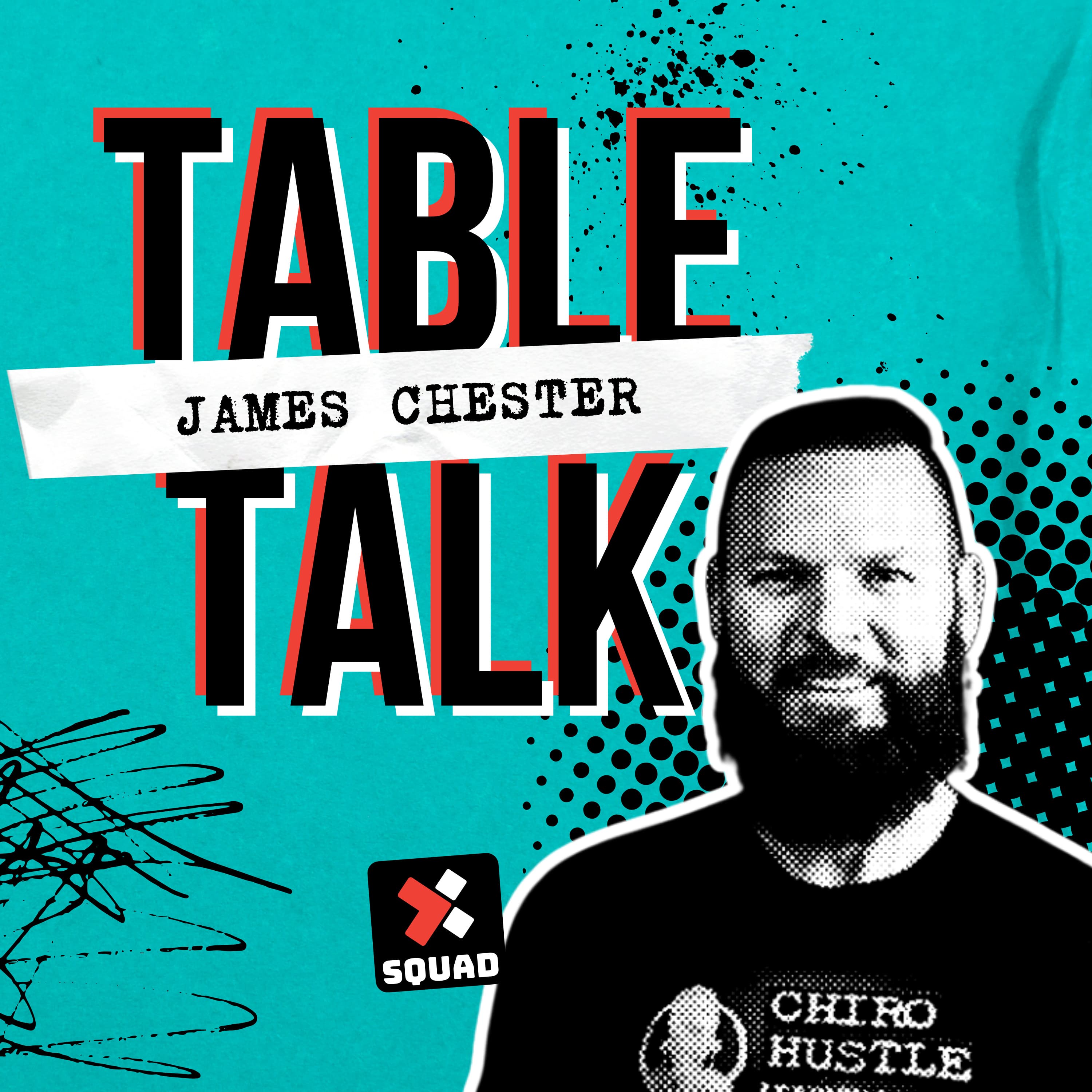
Synopsis
James Chester, host of the Cairo Hustle podcast, joins The Squadcast to discuss the biggest subluxations holding back individual practices and the chiropractic profession as a whole, drawing on lessons from nearly nine years and 1400 interviews. The conversation covers team culture within the profession, the rising cost of chiropractic education, and the case for a declaration of independence from ineffective leadership, giving practitioners a subluxation-focused look at where the profession stands and where it needs to go.
James Chester lays out a clear framework for understanding subluxation beyond a single definition, introducing three distinct tiers that shape how chiropractors think, communicate, and apply care. He explains how staying at a surface-level interpretation limits both clarity and impact, while a deeper grasp connects philosophy, clinical application, and long-term vision. The discussion brings attention to how gaps in understanding at any tier can lead to inconsistent messaging and confusion for both doctors and the public. What becomes clear is that depth of understanding directly influences depth of communication, and without it, even strong intention can fall short.
Key takeaways
- 1
The Profession's Biggest Subluxations
After nearly 1400 interviews, James Chester identifies the recurring flaws holding back individual practices and the chiropractic profession at large.
- 2
Education Costs Are Breaking Chiropractic
Roughly 75 percent of schools now teach medical manipulation without philosophy, and the ballooning cost of education is pushing new graduates away from true subluxation-based practice.
- 3
A Declaration Of Independence From False Leadership
Chester argues the profession needs to formally break from leadership that has failed to defend subluxation and chiropractic philosophy, and lays out a path forward.
In this episode
Jump straight to any moment.
If you liked this episode, be sure to check out
Episode 32
Why Connection & Community are Vital in Chiropractic with Dr. Paul Reed
Episode 18
Restoring Reason in Chiropractic with Dr. Travis Corcoran
Episode 16
The Greatest Subluxation with Dr. David Serio
Episode 13
The Top Communication Strategies, Branding, & Systems in Chiropractic Today
Episode 44
From Smile to Spine: The Missing Link in Whole Body Wellness with Dr. Gary Glassman
Full transcript
Made by speech recognition, with names corrected. It may contain errors, so check quotes against the audio. Spot a mistake? Tell us.
0:00James Chester Introduces The Cairo Hustle Podcast
Dr. Steve Tullius 0:00
Foreign.
Show intro 0:04
Wants to make a bigger impact. What's getting in your way? You're tuned into the Subluxation Squad podcast. One squad, one mission. Chiropractic for all.
Dr. Steve Tullius 0:15
Hey everybody, welcome back to another episode. Pacha, good to see you as always. And today we have James Chester, who is not a chiropractor but arguably knows more about the chiropractic profession than most individuals and many chiropractors out there because he's been deeply involved for many years running the Cairo Hustle podcast. And James, welcome to the show. Why don't you tell everyone more about yourself so they can get to know you well.
James Chester 0:44
Yeah, thanks for having me. Been doing interviews for almost nine years and been supporting the profession for around 17 in some capacity. And yeah, just the, the tenants of my show are protecting freedom of speech, medical freedom, family health freedom, supporting philosophy, protecting the sacred trust, supporting subluxation based chiropractic and the real philosophy which is innate, universal and educated and helping people build stability within that message framework and be able to tell their stories and to live a good life and do it chiropractic, you know.
Read the full transcript (7,571 more words, 11 more chapters)Hide the rest of the transcript
Dr. Steve Tullius 1:25
Yeah, pretty, pretty simple. All based upon really solid principles there.
1:31James Chester's Path Into Chiropractic
Pacha Hornaday 1:31
What's, what's your story? I'm curious, like, you're not a chiropractor yourself, but how, how did chiropractic pull you in?
James Chester 1:39
Yeah, you know, stories are really important, I think, and I ask people a lot of stories too, so I'll share mine. Davenport, Iowa is my hometown. You know, I think that when people hear that, they think that I'm from some magical place when it comes to chiropractic, but really it's kind of a gritty town. It's definitely, you know, when I think about, I think about like, you know, the first chiropractic adjustment. I think about the Harvey Lillard story. I think about, you know, this strange man with a big beard coming down from Canada establishing chiropractic as a magnetic healer in, in my hometown.
So it kind of has like this, I call it Palmerland. You know, I, I kind of think where I come from is this, this magical chiropractic story land place. But really it's, it's the roots of the profession. And you know, I got into it when I was 16, got adjusted and I always knew that I performed better. So I knew there was something really special about the profession, but I didn't really grasp it. And then as I was going through, you know, my high school years and college years, I would consistently get adjusted, but I still didn't Understand anything really about the profession.
Except for that when I got adjusted, I performed better and felt better. And not till 30 did I get the idea that chiropractic had a place for me to help it. And I started working in a clinic at 30 years old. And yeah, I mean, 17 years later, here we are. So that's, that's kind of a time capsule of how I first got introduced to it and then where we are today.
Dr. Steve Tullius 3:33
Awesome.
Pacha Hornaday 3:34
Wait, how did, so how did. Sorry, gotta dig a little deeper here. How did that happen that you get adjusted and you realize, oh, this making me feel better. But like, what is the, you know, it's like the same for doctors. Like, okay, a lot of them have their own chiropractic story. Like I, you know, I got adjusted, it helped me with whatever and you know, I decided I want to, I want to become a chiropractor. So what was, where was that shift? Like, was that like one day you were like, oh, you know, I wonder if there is more I can do? Or like, you know what I mean?
It's not like, like you get adjusted for so long and then you're like, okay, now I got a job. But what, what drew you into it?
James Chester 4:14
Well, it's something that I saw a deep rooted belief system in it for me. And I saw that it was perform. It was a performance based quality of life for me. I was an elite athlete, played all around the world. Soccer, some people call football, but I was an elite soccer player. And I knew that when I got adjusted, I sprinted better. And I knew that when I was under regular chiropractic care, I performed better on the field. So it was super important for me to get checked and adjusted before games and after games. And I just made it a part of my life.
And as I started to realize that performance was an important part of my life, I made this pact with myself to always be adjusted. And I knew that because of my own personal performance that it had a huge impact on my quality of life. And I didn't have. Somebody didn't sit me down one day and tell me what a green book was. You know, somebody didn't sit me down one day. And you know, explain Palmer's law of life. Like, no one sat me down one day and just told me what. I mean, probably about 27 years old, one of my chiropractic buddies who was going through Palmer told me what innate was. I'm like, that's a stupid ass word.
Like, that doesn't mean anything to me. Like, I was like, you guys are using this weird word that nobody understands, and I don't understand it. And I'm pretty smart. And I'm like, you guys got to find a better way to communicate to people on that for sure. And when I was 16, I'll tell you, like, I hurt myself playing high school, like tackle football, and my shoulder got injured and the athletic trainer told my mom, hey, you should take your son to Palmer and get some X rays on his shoulder. Because they had like, you know, a discount clinic over there. So they would do adjustments at a discount and they would do X rays at a discount.
So my mom, you know, I'm the youngest of five, grow up in a single parent family, and my mom was like, sure, I'll take my son over to Palmer. It's right across the street from my high school. And I get X rays on my shoulder. And the staff doc there, I think her name is Dr. Anna Livdinsk. She said, can we X ray your son's spine to see if there's any subluxation? And my mom was like, sure. You know, she was a nurse's aide, she worked in the medical world, so she knew the value of healthcare. And she's like, sure, you can X ray it.
And they X rayed my spine and you know, for subluxation and found that, you know, getting adjusted to be helpful for me. So I think it was really cool that they got me into that type of model early on, but I still didn't know what the hell a subluxation was, you know, So I think there's
Pacha Hornaday 7:25
a. Chiropractors actually explained it to you at some point.
James Chester 7:28
Yeah, but still, once again, it didn't like, land. It didn't make sense. It's one of these big concept words that the common person kind of glosses over and. And they're like, yeah, sure, like, it's
Pacha Hornaday 7:41
like trying to explain it explained it well enough. I got it explained by Dr. Steve Tullius is right here. He was my chiropractor. And it blew my mind. I was like, holy cow, how does nobody know about this?
Dr. Steve Tullius 7:53
I am an overachiever. I'm not gonna lie about that. But you know that what I'm hearing though, is that you know what chiropractic is? It's very experiential. Right. You. And that was how I actually decided to become a chiropractor is because of my experience. It made sense when it was explained to me, like, the power that made the body heals the body and that the nervous system controls everything and. And if there's pressure on that system that you're not going to be at your best. But it wasn't until I had an injury and recovered in a time period that normally doesn't happen out there in, in the other version of reality.
And, and then even that wasn't enough. It was, it was over time. I was realizing, wait, I'm not getting sick. I'm not like, not that I was getting sick often, but just my overall quality of life was much better. So you experienced that, James, and then you decided, though, that this thing is so big that I need to, and I have the ability to help chiropractors. And you must have identified that there's gaps, right? Because, I mean, on your shirt there it says learning from the greats.
And your podcast over the years has been doing that, bringing some of the greats to the, to the profession so that the rank and file chiropractor can fill those gaps, I assume. So on our podcast here, we're talking about the biggest subluxations in a chiropractic practice and in the profession that are holding the practitioner and the profession back. So I really would love to hear what you've found through all these interviews. I think it's like almost 800, right? What have you found to be the biggest subluxations in the practice and profession?
9:12The Biggest Subluxations In The Profession
James Chester 9:38
Yeah, you know, I, I want to turn the clock back a little bit because I didn't get a chance to finish like, how I got into the profession ultimately. I was 30 years old, me and my buddy, he was working as the guy that took IDs at the piano bar I was bartending at. And one night we were up till like three in the morning on the rooftop overlook the Mississippi River. And he said, what are you gonna do with the rest of your life? I was like, bro, I'm good. I was like, I have a really sweet life. I, I do this and quality of life is great. I travel around the world. I, I make more money than almost anybody else in town doing what I do.
He goes, no, no, no, no. What are you really doing with your life? He's like, I see you, you're actually killing yourself. And he's a chiropractic student too. He's like, I'm going to open up a practice and I think you're really good with people and I think you'd make a great contribution to help me run the practice. So it took a lot of courage for me to leave this, like, kush life where I was basically a living legend and a Functional alcoholic. And anyways, I'm seven years sober now, which is a huge, huge, like, feat in today's society.
But I took the chance and I went up to Arlington Heights, Illinois, and I worked in a chiropractic clinic. And I was basically a working machine. I learned how to do CBP traction setups. I learned how to do marketing. I learned how to do notes. I learned how to mark X rays, I learned how to do talks. I learned everything under the sun that you can possibly do, plus cleaning the toilets and vacuuming the floor and turning the lights on in the morning and turn the lights off at night.
I did everything but doing a insurance verification because I saw what that looked like, and I'm like, hey, bro, I'll do anything under the sun for this clinic, but I won't do that. I won't sit on a call and do the benefits calls, because that looks like hell. But I'll clean toilets, I'll carry the trash out, I'll vacuum floors, I'll do notes, whatever it takes, but I won't do that. So I got really clear. I went up there and studied everything that Deed and Don Harrison ever produced. I studied the art of communication, everything that Brad Gocky ever put out. I studied everything that gosh, Fred D. Domenico produced.
And I was just, like, in the trenches when I wasn't working, I was studying. I was watching everything that Billy Demoss did, everything that Reggie Gold produced, everything that Jim Sigafoose produced. Like, I was, like, studying the game. I was learning the communication. I was learning the big why. I was learning, like, the methods of, like, taking this thing to the next level. And I really dedicated the first three years of my career to just figuring out how to understand the profession so I could communicate it better to the patient.
But also, I see in miracles, they would send me around to do interviews with different chiropractic offices and do these patient testimonials. So I was doing commercials for different areas in Chicagoland, and then I would do some, and they would travel me around to different cities. And I was like, interviewing patients and I was listening to how they were recovering and how their lives improved. And I did that for about two years where I would just talk to patients and go around to different offices.
And I took my knowledge skill that I had about working in the clinic, and then I started doing screenings, and I started to realize that everybody was looking for something to improve their life. They just didn't know it was called chiropractic. And then I'll answer your Next question. Because I think that is pertinent. Almost nine years of doing Cairo Hustle, and the real number is about 1400 interviews, and most of those are in live settings. So I'll go to an event and I'll set up a microphone stand and a light or two in a backdrop, and I'll pull people. And it's the hardest job in the world, I guarantee you. Nobody's fit for that work.
Nobody can handle on the spot stuff, but I learned to just like, if I could just get this person to tell me, like, what their favorite parts of an event was and who their favorite speaker was, it was magic. So half the work I've done is interviewing chiropractors live and setting at chiropractic events. So state associations, big seminars, things like that. And I learned that if I could do 10 interviews a day, I could help promote that event, and it would get the message of that event outside the four walls of that event. Really cool stuff. But what did. What did I learn? What have I learned? That's where we're going.
I learned that there's a huge subluxation in the education. I learned that there's a huge subluxation in the philosophy camps, and I learned that there's a huge subluxation in how people learn to deliver the art of chiropractic. So the education is one tier, the philosophy is another tier, and the delivery of the adjustments another tier. And I think we can correct some things, but I think that we have a lot of work to do as a profession. But I just gave a talk last weekend in Missouri, and I said, who in here feels like they're on a chiropractic team? Do you feel like these people next to you are on the same team as you?
Not one hand went up. That's the biggest subluxation is people don't feel unified. They don't feel like they're on a winning team. And I said, well, if I was the coach, chiropractic, I'd tell you guys that we're. We're going to go to halftime, and we're going to have a talk, and we're going to come out and we're going to support each other. We're going to come out and we're going to actually win. And we're kind of past halftime, but I'm just going to pretend it's halftime. And I say, you guys need to, like, look at each other right now and see how we're going to win together. And that's the only way that this gets better.
And I go, and by the way, next time when these events pops off, you got to bring a, a younger chiropractor with you and you got to bring somebody here that isn't a part of this community that's a chiropractor that, you know and just make them sit right next to you. And I was like, that's the only way that you guys are going to grow this organization is to promote the young into it and to get people to start being leaders that aren't here today. So I know I said a lot there. Hopefully some of it was like usable and it answered most of what you were looking for.
Dr. Steve Tullius 16:36
Yeah, no, I think that, I think you're spot on in terms of that team question. It makes me reflect on, you know, I was just at a. Seminars at the Chiropractic Society of Texas. I believe if you had asked that question there that the, the hands would have gone up more. So I would have raised my hand because I definitely feel like I'm on a team. I'm also, you know, I'm a little different. I'm, I'm, you know, on the board of a chiropractic college. I'm as co chair of the MAHA Chiropractic working Group. You know, I've been involved in chiropractic politics for a super long time. So. So I, I'm, I feel like I'm on a team.
I know that and I know this about that team and I. Well, I know that there's multiple teams right now, right. Playing.
Pacha Hornaday 17:29
And that's what I was gonna ask. Like, how do you guys define team? Like who's on our team?
17:30Building A Team Culture In Chiropractic
Dr. Steve Tullius 17:35
Well, I'm, I'm actively working to ship, you know, to help the culture embrace the teams. Right. Within. Within core values. Right. Of that you've identified, James, are philosophy, an innate philosophy, but more so like a vertebral subluxation corrective service. Right. That that be the core value. And then. So if anyone doesn't accept subluxation within the profession, if anyone says that X ray is not necessary, if anyone says that we should have drugs and surgery, then I view that as they are on an opposing team. So I'd love to hear your perspective on that.
If I'm seeing that accurately, maybe I need to see it from a different vantage point.
James Chester 18:25
I'm not sure I exactly understand what you're looking for, but I don't think that anything that is medicalized other than research papers, I guess because it comes from a medical angle. And I think when you talk about drugs and surgery specifically, I don't think it has any place into the healing art of chiropractic. And yeah, I believe that subluxation centered chiropractic is something. It's. It's kind of like different languages, okay? Like, there's a language for interprofessional network, and then there's a language that goes out to the broader audience, which is, you know, different disciplines of the health world.
And I think that people, like, I early on felt like, what the hell is this word innate? What the hell is this thing Subluxation? It's a. It's a different language. And you can't assume that everybody understands what we understand because it takes a long time for us to get to the point where it makes sense to us. So we have to meet people where they are a lot of times. And not to say anybody's like, opposing to understanding more. It's just some people just aren't prepared to understand it.
But when it comes to, like, the profession of chiropractic, for them to be opposing to that language, like, shame on them, like, seriously, like, what are you doing? Like, you could have done anything else under the sun. You could have done anything else for a career. And the. This is what makes you a chiropractor. The science, philosophy, and art of chiropractic. And if you oppose that, then, hey, there's plenty of opportunity to go out there and work at Home Depot.
Dr. Steve Tullius 20:08
Yeah, I'd love to hear Pacha's take on that. Cause Pacha is also not a chiropractor. We talk about these things all the time on this show. And just that's actually why we created this podcast, because we were talking about it all the time and we figured, you know, why don't we, like, talk about it in front of someone else too and bring others on so we could have these conversations. So, Pacha, what are your thoughts on that?
Pacha Hornaday 20:29
The. My thoughts on who's on the team and who is not this team thing,
Dr. Steve Tullius 20:33
because, you know, James is identifying that the chiropractors don't feel like they're on a team or a winning team. You know, there's. There's two and then there's multiple teams. And now we have this other team that. That both James and I are saying that doesn't belong on the court. So what are your thoughts?
Pacha Hornaday 20:53
Maybe they belong on the court, just not under that name, you know, But I actually like what you said, James. Like, if. If you choose chiropractic as your profession, then you Know, do chiropractic. Like, if you want to do any of the other things, whether it's surgery or medication or what, there's. There's plenty of professions out there that you can choose. And, you know, but if you want to do chiropractic, then just do chiropractic, right? So that's kind of.
James Chester 21:24
Well, I. I also asked them, after I made that point, I said, who in the room knows the rules to cricket? Nobody's hand went up. I go, exactly. And I go, that's how people feel about. When you talk to them about chiropractic. They just don't know what chiropractic is. They just know that when you adjust them, it's supposed to feel better, and they're supposed to. That their life's supposed to improve. And I said, and that's why people don't know how to play on the team the right way, because they don't understand what they're playing for.
Pacha Hornaday 21:56
And so where's the problem with that? Like, so is it, you know, like, somebody chooses to become a chiropractor and go to chiropractic school for a reason? It's. I mean, I understand the blame we're sort of putting on schools for not teaching enough philosophy and, you know, like what chiropractic actually is. But it's like, it starts before that. I mean, you know, to a certain degree, like, you have a certain expectation when you want to become a chiropractor. Well, I'm just curious.
22:25Continuing Education And The Future Of Chiropractors
James Chester 22:28
I think. I think the key word that you said is education. And what's the responsibility? There's a lot of responsibility. It's for the person that shows up, and it's for the person providing. And the student is the one that shows up. The learning institution, the ones that provide. And there has to be, I guess, a model that makes sense. And it has to make sense financially. It has to make sense by application. Like, I. I talk to docs all the time. You ask me, Steve, what have I learned?
Well, I learned that I talked to a lot of people, and they say that they have a hard time hiring people to work in their offices because they don't feel like this generation of chiropractors can actually adjust. And I'm like, well, that's like having your AC unit out and you call somebody to fix your thermostat, and they can't fix your thermostat. They should do that one thing that you need them to do. And if we have people coming out as a certified, graduated chiropractor and they can't do the one thing that they're supposed to be able to do, like what are we doing, guys? Like, that's a big fail in my opinion.
When you talk about somebody going in and paying to become a chiropractic adjuster and the part that they can't perform is the art, then they're destined to fail. So back to the education thing. That's a huge subluxation. The cost of the education plus the application of the actual graduate. So I'm not sure how to fix that other than, you know, require every chiropractic student to go on a mission trip and get their hands on as many spines as they can and you know, get them quality introduction to Patient Care rather than some stuffy ass. You have to get this many adjustments to be able to walk the line and graduate.
I don't think that makes a great chiropractor, obviously. It's what the people tell me. So just saying that, hey, you graduated from a school that's accredited and you got a degree doesn't mean that you're going to be successful. Number one. Doesn't mean that you know how to adjust. Number two, that's a massive subluxation.
Dr. Steve Tullius 24:54
Yeah. You know, I mean, what we're discussing is a multi domain problem, right? There's, there's, there's, it's not one area, you know, we, you mentioned economic viability, right. Of this model. Like this model has to be economically viable and, and they need to be able to, one, they need to be able to come out and do the skill. Which by the way, that was, you know, that was a complaint back when I was first coming out of school too. And I, I came out of school where I did not learn the art of detection. Correction. I learned the, I learned how to do medical manipulation is what they taught us there.
And, and so that's another huge issue is that approximately 75 of the schools are teaching medical manipulation with no philosophy. Right. And so there's no pre and post check. There's all these things. So we're, we are teaching two different disciplines within the profession and then, you know, even they can come out of the best schools and still not know the philosophy or, or not have a, not be ready to step into and have a viable economic model. So these are, we're currently working on a strategic plan, the Chiropractic Freedom Coalition that has every, every single piece that you're talking about.
So I can't wait to share it with you and others because it's we have to start somewhere and, and we also need to be on the same team. And that's, that's one of the things I've seen over the years is we're so close. You know, we're, we're so close in so many ways, yet we, we're in our camps, we're fragmented. Right, that's, and that's part of the, the plan too. We, we have to end the fragmentation so that we're all moving towards a common goal of getting mass utilization of vertebral subluxation focused chiropractic to the world. And I'm an optimist, so I believe that it's possible and I also believe that it has to be happened.
There's multiple spokes to this problem.
Pacha Hornaday 27:05
I, I think that, you know, there's, there's this implementation like all those things that we have to do, like we have to fix education and we have to fix the skills of, of chiropractors. But I think it, it all starts with this definition of what chiropractic is. Like, what is the team? Right? Like, I feel like that's where we got to start. So the people that agree can join the team and be clear, I'm on this team. And it's the people that, you know, don't agree with whatever we define as you know, this is what our team is about, then they are very clear. Like, I'm not on this team.
I feel like that hasn't, I mean it has been done to some degree, but it's not, There is no one document or maybe there is and I just don't know about it that says this is what it is and everybody has access to it and sort of like you sign your name under it and say, I'm part of this, I'm part of this team.
Dr. Steve Tullius 28:10
I, I'd like to hear your take on that, James. Like the, the team. Who, who do you consider to be on the team?
James Chester 28:19
Every chiropractor. There's 60, 000 of them and that's just the United States. And they all have to be playing on the same team. Otherwise we're, we, we will get beat by somebody.
Dr. Steve Tullius 28:32
But. Oh, sorry, go ahead.
James Chester 28:35
No, I, I, There's a small profession, very small, and the numbers are really, really thin. And the median age of a chiropractor right now is 55. So we have an aging workforce. We have a disconnect between the youth movement to that workforce and we have a fail rate of 50%. That's what happens when there's no identity with on the team. We don't have a farm team that's producing the chiropractors, that's proctoring them, that's producing them and getting them to be league ready. We hope that if we throw them in the deep end they can freaking swim and we don't teach them how to swim properly.
And that's the problem is it's every chiropractor for themselves. You all live in an island and good luck. Hopefully you can learn how to feed yourself and pay your bills. And that's what the team has been doing for a long time and there's no unity. And I think that if you go that route any longer, I, I even said at my last talk, chiropractic is an endangered species on, on the provider list. We aren't seeing the schools grow with, with enrollment. We're seeing massive fail rate for graduates and the old guard will be working out in the next decade. So there's a massive gap to fill.
Dr. Steve Tullius 30:13
So I, I agree with you. These are things that I 100 agree. There's one piece though that I, I, I'd like you to clarify. You said, you said every chiropractor and that there's 60000 but you also said that there's those that anyone who wants drugs and surgery and doesn't accept subluxation is not on the team. And so then we have then that, then we have to address that. What, how many don't do we know? Well 1. Are there chiropractors who want drugs and surgery and want the removal of sublimation?
James Chester 30:49
It's pretty easy. You fire them like you're not, you're not allowed on the team anymore. You've, you're a traitor. And I think chiropractic needs to sign a declaration of independence from false leadership. And I think that has to start like yesterday. You know they ask you when the best time to plant a tree, it's 10 years ago or today. And I think that's the same thing that when it comes to weeding a garden if you want to see things grow and prosper, you have to take the weeds out.
30:55A Declaration Of Independence From False Leadership
Dr. Steve Tullius 31:21
Yeah.
James Chester 31:22
And I think that there's, there's a lot of weeds out there growing in the profession and there has to be a division say look, you guys want this? Hey, don't call chiropractic. You're welcome to take that idea and evolve it into whatever you want to, but that's not what chiropractic is. Sorry.
Dr. Steve Tullius 31:37
Yeah, I'm with you. I absolutely am in fact, Arno Bruni and I tried to do this in 2012 with the movement for chiropractic quality and integrity, of which Pacha made the logo. Thank you. And, and she's wearing this beautiful necklace, which also with the, with that movement, we had different colored logos very purposefully because it was about diversity. It was about, it was about unity around our core values of subluxation and vitalism. You know, drugless. You know, drugless and without surgery and, and acceptance within those, within that. That was the team. We, we defined it. We had great success at the time.
We, I think we would have even more with, with the, you know, AI and everything that we have today, which is what the Chiropractic Freedom Coalition has now evolved to. And I got to tell you that if, after this, this, I'll show you some really cool stuff that we're doing. But I will say this. The leadership at the time was unwilling to make that declaration. They. And, and there's, and it's tied to finances, it's tied to friendships over principles, and it's tied to weak leadership in general.
And so I think this is where we do need to make that declaration that the challenge I'm seeing on that is that that other side, they have infiltrated massively. And so I, and with that said, I do believe that there is a plan and there's a way out. And it's absolutely the team that you're describing and the. On the straight, you know, the straight side, which I feel like we're moving away from, that we need to start having acceptance and stop shaming this. There's all this shame if someone decides to do something else in their practice. And I'd love to. Yeah, go for it.
33:40The Case For Lowering Education Costs
James Chester 33:40
Can I tell you why they do other things in their practice?
Dr. Steve Tullius 33:44
I'm. I'm pretty sure I know why, what you're going to say, but. Yes, let's. Let's hear it.
James Chester 33:49
Well, they don't know how to support themselves with a chiropractic degree and they have to go add other things to their practice to make a few bucks so they can drive a cool car and they can buy their kids Christmas presents. And I think that that's the real truth of why people add other stuff into their chiropractic offices. Now. I'll tell you, I travel the world in Mexico. Guess what? They don't do any of that. You know what they do there? They check, detect and correct vertebral subluxations. That's what they do at chiropractic offices. Because you know why? They don't have debt. They finish college with $1,000 in debt.
And you know what they do? They don't take undergrad, they finish their school degree, they go right into their program. They finish their program younger, no debt, and they go practice real chiropractic. So if we want to fix it, we got to follow that model. And that's, that's the way it gets done. You graduate students with no debt, you let them come into a program at a younger age, and that fixes a lot of the, that's happening in the chiropractic profession that we know it in the United States.
Dr. Steve Tullius 34:55
Yeah, no, I'm with you. It's. Those are all the things that have to happen. The cost of education has to drop dramatically. All the extra BS that the accreditation and testing systems require enforce, which as we're, we're sharing, you know, that the common belief out there is that students are coming out, not having the skill set to perform the art. Well, what does that say about our testing, you know, system too? Right. It says one thing about our schools, perhaps. But what does it say about the accreditation process and the testing process as well?
James Chester 35:29
You know what those students do, Steve? They still fail at practice in five years at 50% rate.
Dr. Steve Tullius 35:35
Yeah, absolutely. And, and nobody cares. The emperor has, is wearing no clothes and, and now they're, they're, they're trying to consolidate that power even more.
James Chester 35:43
So people lie, numbers don't. Until the whole scamdemic popped off, and then the numbers lied, too. But before that, there's an old saying that people lie, numbers don't. And if people want the real truth, don't listen to me. Go look at the numbers and you can see for yourself where the problems are. It's not from some independent journalist that interviews chiropractors that is basically surveying the profession.
Dr. Steve Tullius 36:13
It's.
James Chester 36:14
You can go look for yourself. You can see where the, the gaps are and the pain points and the fail rates, and you can determine if things look peachy. Keenan. Right on. And if they don't, maybe you can be the power of one and you can go and figure out how to fix these things. And I commend you guys for doing the work with the coalition and figuring out ways to fill that gap. But it has to be a sobering conversation, too, for the other side to say, hey, whatever we're doing, it still isn't producing quality chiropractors that are successful.
So no matter how much we want to ratchet down and tell people what they have to do to become a chiropractor. Hey, maybe they should go to school in Mexico and get a degree with no student loan and no debt, and they should come back to the United States and practice, because that's what I think should happen. But I'm just an independent journalist that runs a podcast that specializes in new patient acquisition. What do I know?
Dr. Steve Tullius 37:13
I think you know a whole lot about this problem, Pacha. Other questions for James on this. So should we move over to the rapid fire? What do you think?
Pacha Hornaday 37:26
Yeah, let's rapid fire it.
37:30A Belief James No Longer Holds
Dr. Steve Tullius 37:30
All right, we end with the rapid fire round here. James, really appreciate all your takes on all this stuff here. Pacha, do you want to get started?
Pacha Hornaday 37:41
Sure. I mean, some of the questions we always ask, we kind of touched upon already. But to sum it up, and you know, just keep it short, what conversation in the profession is not happening? That should be.
James Chester 38:01
What it takes to make a successful chiropractor in every state.
Dr. Steve Tullius 38:07
What belief do you hold strong? What. What belief did you hold strongly five years ago that you now think was wrong?
James Chester 38:22
That's a good question. What was I wrong about five years ago? That I was gonna marry the girl that I was dating?
Dr. Steve Tullius 38:34
I think we've all been there.
Pacha Hornaday 38:40
Okay. Okay. Well, I guess along with that, like, what's something that nobody knows about?
James Chester 38:47
Oh, gosh, what does some the world not know about me? As a young kid, I grew up on the streets. My dad left when I was five and I grew up in a bar. And about seven years ago, or eight years ago, maybe 10 years ago, I was in a coaching group. And I've always resented my dad for leaving my family and the coaching. My coach at the time said, next time you go speak on stage somewhere, you have to not only tell people that you love your mother and you love God, you have to tell them that you love your dad too. And I was like, why the would I do that?
He said, because you're the man you are today for the reasons that are because you helped raise yourself without him. And I said, cool, I'll forever do that now. So what people don't know is probably is I do love God. I love my mother and I love my dad. And it's really, it's a grown up thing for me to realize. But I think a lot of people can find clarity in that. What I found clarity in.
Dr. Steve Tullius 40:02
Yeah, absolutely. Thank you for sharing that. What's a. What's a sacred cow in chiropractic that needs to be challenged?
40:05Challenging Chiropractic's Sacred Cow On Education Costs
James Chester 40:16
The cost per education. And you know, I banged the drum on that during today's interview is we have to really make it affordable and we have to get students into programs earlier in their careers. Because there's not too many times I meet somebody that even considers like, even considers that they went to undergrad or what they went to undergrad for or how much that degree cost, that they're not using that now. They have to like springboard into a program. And nobody cares what college you go to when you're in practice. I'll just tell you that right now.
You might, but nobody's ever going to come in as a, a patient of yours and say, hey, what college did you go to? Yeah, unless they have some like, familiarity with Palmer maybe. But they're not going to come in and ask you like, what school did you graduate? What was your gpa? What was your, your order in your class? Like, nobody gives a rip about that. All they care is that you can do the one thing that they came in for and that's to adjust. And I think that we over complicate the whole thing and it can be much easier for people to actually become chiropractors. And I think that that's the sacred cow that needs to be exposed.
Pacha Hornaday 41:34
Cool. Okay. You're actually the perfect person to ask this question. We ask all our guests, but you have interviewed so many people, so this is a perfect question for you. Which three people should we have as guests on our show next, considering you know, what the show is about and what we're trying to do here?
41:35Three Guests To Book Next
James Chester 42:00
Well, one of my all time favorite people to interview is Billy Deas. If you guys haven't had him. He's always, I believe, got a great message and I, I think that he's always stood in the gap from my early days of telling the story. I think honestly one of the most brilliant minds in chiropractic that everybody should get to know is Deed Harrison. He's a no frills, no guy. He's done more research on this profession, for the profession, I believe, than any camp. If we want to talk camps, the chiropractic biophysics camp is definitely some movement that is doing the work.
And I think that their message, especially deeds, should be massively supported. Gosh, you know, my mom would always say I love all my kids the same, you know, and I, I kind of feel that way about my, my friendships in this profession. I just know if that we want people to get to the front lines and hear the right people. I, I've been curious a lot to like, see who would Go on to Joe Rogan and who would be the chiropractor chosen for that? And I. I always, you know, go back and forth with who it should be, and I choose myself. You know, I think that he loves underdog stories. I think that he would resonate with a lot of my messaging.
And, you know, being an advocate for this profession, I. I really believe that I would raise my hand. And, you know, I think that I could settle the score with that MFer. And. And the. The third person, you know, just because I think that she's dynamic is Heidi Havoc. I think that she has a lot to say, and she's very influential. And I. And I. I'll throw a fourth one in there because I think women voice, the woman's voice needs to be heard, and she's doing so much work day in and day out of Sherry McAllister with the foundation for Chiropractic Progress.
I think she has a big message, and that's to really bring all chiropractors to the table. And I think that she's very diplomatic, and she does a great job of expressing that, and she has a lot of support. So that's. That's my. My suggestions.
Pacha Hornaday 44:39
Awesome.
Dr. Steve Tullius 44:39
Those are great suggestions there. All right, so final question. What does an unsubluxated profession look like to you?
44:41Where Chiropractic Is Headed In 20 Years
James Chester 44:58
I've been to DE once, and I love their servant message. And I think that chiropractors first have to find themselves as being servants
Dr. Steve Tullius 45:12
and
James Chester 45:13
do it for the right reasons. And if you don't, there's an endangered species list out there, and definitely it's something to consider. One of my favorite questions to ask people is, where do you see the profession going in the next decade to 20 years? And my answer to that is, wherever. We. We just got to keep telling this chiropractic story. And that's why I started Hustle. It's because I wanted to document the profession in case anybody ever wanted to change it. We could go to court and we had testimony of 1400 people talking about this beautiful profession of chiropractic.
And nobody could ever filibuster if you shared interview after interview of what chiropractic is from the testimony of the chiropractor. And that's why I started Hustle, because it is a time capsule of truth that if anybody ever tried to change the definition of chiropractic, you could take it and play it for a year straight, and it would hold up in the court of law, and nobody could change the definition of chiropractic. So we have evidence and we have truth. And I think that that's what we need to really focus on is producing the message and staying true to the message and do it more than anybody else could ever imagine.
And I believe we've accomplished that with Hustle. So that's kind of how I believe that the story gets to more places, is we just have to tell it. And the day we stop telling it is the day someone else will make up one about us. And they do a good job of that.
Dr. Steve Tullius 47:03
True. Well, thank you so much, James. This was a fantastic time we got to spend with you. I really appreciate you giving us this time and your perspective for those that want to learn more about you, work with you, get, you know, find your podcast, tell us all about how they can interact with you.
47:05How To Connect With James Chester
James Chester 47:23
You can send checks to my personal home. I'm just kidding. I like Cash app. I like Venmo. Whatever you approve. Zel's better because it goes right into the account, but, yeah, I mean, people have to vote with their dollars, right? And it seems that people like what I do, and I'm always looking for support, and, you know, sometimes I get the question, what's the ROI on that? Well, you're supporting somebody that supports you, and I think that people need to hear that. But if people are curious to reach out for friend reasons or to be on the show, reach out to me on Facebook.
DMS are always open, and I'm always looking for people to have good, quality conversations with about this beautiful profession of chiropractic. So if that's you, I'm always open for that.
Dr. Steve Tullius 48:15
Awesome. Thank you so much, James. Appreciate you and the time we got to spend with you today. All right, everybody.
Pacha Hornaday 48:21
Yeah. Thank you.
Dr. Steve Tullius 48:23
See you.
James Chester 48:23
Thank you.
Pacha Hornaday 48:24
Till next time.
Subscribe and review
If this hit, help another chiropractor find the show.
If you love this episode, please take a moment to subscribe and leave a review on Apple Podcasts or Spotify. Your support helps us reach more chiropractors who need these insights. Thanks for tuning into the Squadcast. See you next week.